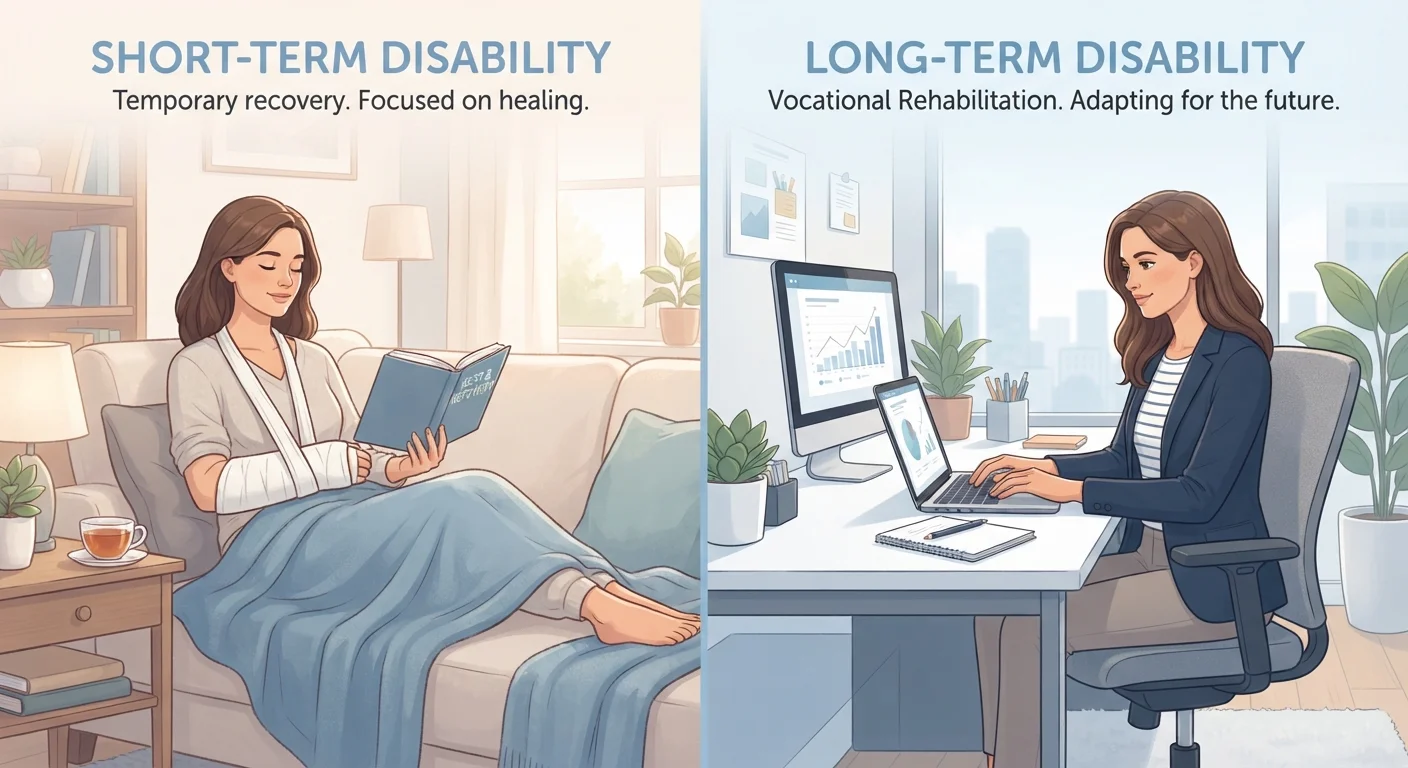
What Disability Insurance Actually Does
Disability insurance replaces a portion of your income - typically 50-70% - when a medical condition prevents you from working. It is not health insurance, which pays medical bills. Disability coverage focuses on your paycheck.
Most Americans understand that car accidents or serious illnesses can happen unexpectedly. What's less appreciated is that a disability - whether from a back injury, cancer, or a mental health condition - can interrupt income for months or years at a stretch. Disability insurance exists to keep your finances from collapsing during that period.
Two main types exist: short-term disability (STD) and long-term disability (LTD). They cover different time windows and serve different financial needs. Understanding both is a foundation of solid financial planning - for more on insurance coverage fundamentals, see Coverage Basics.
This article provides general educational information about disability insurance. It is not personalized financial or legal advice. Policy terms, eligibility, and coverage vary by insurer and by state. Consult a licensed insurance professional before making decisions about your own coverage.
Short-Term Disability Insurance: The Near-Term Buffer
Short-term disability insurance typically kicks in within days to two weeks of a qualifying disability. It pays benefits for a relatively brief period - commonly 9 to 26 weeks, though this varies by policy.
Common triggers include surgery recovery, pregnancy and childbirth complications, non-work-related injuries, and serious acute illnesses. Many employers offer STD coverage as a workplace benefit, sometimes at no cost to the employee.
Key features to understand:
- Elimination period: The waiting period before benefits begin, usually 0-14 days.
- Benefit duration: How long payments continue - most often three to six months.
- Benefit amount: The percentage of your gross income replaced, subject to policy limits.
Coordinate STD and LTD Timelines
When reviewing coverage, check that your short-term policy's benefit period overlaps with - or at minimum runs up to - your long-term policy's elimination period. A gap between the two could leave you without income for weeks. Ask your HR department or insurance agent to confirm how the policies are coordinated.
Because STD coverage has a shorter benefit window, it pairs well with an emergency fund. A savings cushion can cover the elimination period and supplement any benefit gaps.
Long-Term Disability Insurance: Protection for Extended Inability to Work
Long-term disability insurance picks up where short-term coverage ends. Benefits typically begin after 60 to 180 days of disability and can last for two, five, or ten years - or until you reach Social Security retirement age, depending on the policy.
LTD coverage is particularly important because statistically, disabilities lasting longer than 90 days tend to last much longer than people expect. A disabling condition that sidelines someone for years is a financial emergency of an entirely different magnitude than a six-week recovery.
| Short-Term Disability | Long-Term Disability | |
|---|---|---|
| Benefit start (elimination period) | 0-14 days | 60-180 days |
| Typical benefit duration | 9-26 weeks | 2 years to retirement age |
| Income replacement rate | 50-70% of gross income | 50-70% of gross income |
| Common sources | Employer group plan | Employer plan or individual policy |
| Definition of disability | Unable to do current job | Own-occupation or any-occupation |
| Relative premium cost | Lower | Higher, varies by occupation |
| Best for | Short recoveries, surgery, childbirth | Serious illness, chronic conditions, injury |
LTD policies also vary in how they define disability. An own-occupation definition pays benefits if you cannot perform your specific job, even if you could work in another capacity. An any-occupation definition is stricter - benefits pay only if you cannot perform virtually any gainful work. This distinction matters enormously and is worth scrutinizing before purchasing a policy. For questions to ask when reviewing any policy, see our policy evaluation checklist.
Key Differences at a Glance
Short-term and long-term disability policies are not interchangeable. They differ not just in duration, but in cost, elimination periods, and the types of conditions they're most useful for. Employer-sponsored coverage may seem adequate, but limits and exclusions often leave meaningful gaps - especially for higher earners or self-employed workers.
Social Security Disability Insurance (SSDI) exists as a federal backstop, but it has strict eligibility requirements and an application process that can take months or years. It should not be counted on as a primary income protection strategy.
1 in 4
Workers who become disabled before retirement
According to the Social Security Administration, roughly one in four of today's 20-year-olds will experience a disability before reaching retirement age.
34.6 months
Average long-term disability claim duration
Industry data from the Council for Disability Awareness suggests the average long-term disability claim lasts nearly three years.
For workers thinking about comprehensive income protection, disability coverage complements - but is distinct from - life insurance products. If you're also weighing life insurance decisions, understanding term vs. whole life differences is a related topic worth exploring. And if you're concerned about care needs in later life, note that long-term care insurance serves a different purpose entirely - it covers personal care services, not lost wages.