What Each Valuation Method Actually Means
When you file a property insurance claim, your payout isn't simply what the repair contractor quotes you. It's calculated according to the valuation method written into your policy - either Actual Cash Value (ACV) or Replacement Cost Value (RCV). These two approaches can produce very different numbers, and understanding them before a loss occurs can save you from an unpleasant surprise.
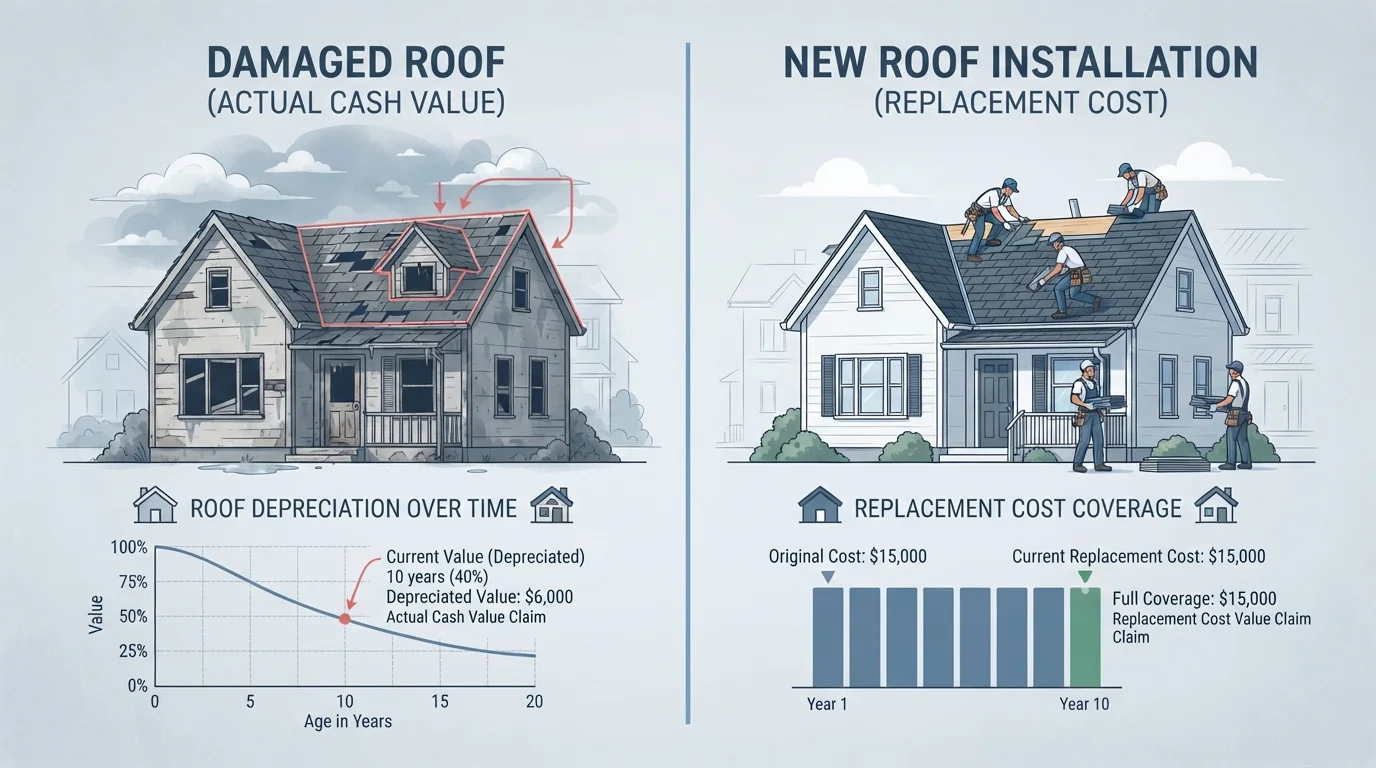
Actual Cash Value is calculated by taking the replacement cost of the item and subtracting depreciation - a reduction that accounts for the item's age, wear, and condition at the time of the loss. A ten-year-old roof, for example, carries significant depreciation. If it costs $15,000 to replace but the insurer determines the roof had depreciated by 60%, your ACV payout would be roughly $6,000. You'd be responsible for the remaining $9,000 out of pocket.
Replacement Cost Value, by contrast, is the amount needed to repair or replace damaged property with a comparable new item at current market prices - without any deduction for depreciation. Using the same roof example, an RCV policy would pay out close to the full $15,000 (minus your deductible), regardless of how old the roof was.
For a plain-language reference on these and other key claim terms, see the Insurance Claims Glossary that covers the terminology you're most likely to encounter when a claim is filed.
| Criterion | Actual Cash Value (ACV) | Replacement Cost Value (RCV) |
|---|---|---|
| Payout basis | Replacement cost minus depreciation | Full current replacement cost |
| Effect of property age | Older items pay out less | Age has no effect on payout |
| Typical premium cost | Lower | Higher |
| Out-of-pocket risk after a loss | Higher - depreciation gap is your responsibility | Lower - insurer covers replacement cost |
| Common in which policies | Often default on older or budget policies | Available as an upgrade or standard on newer policies |
| Personal property coverage | Pays current market value of used item | Pays cost of equivalent new item |
| Depreciation holdback | Not applicable | May withhold depreciation until repairs completed |
How Depreciation Is Calculated - and Why It Matters
Depreciation isn't a fixed number - it varies by item type, age, and the insurer's own schedules. Insurers typically use depreciation tables that assign a useful lifespan to different property components. A roof might have a 20-year useful life; carpet, 10 years; appliances, 15 years. The older and more worn the item, the larger the depreciation deduction under an ACV policy.
This is where many policyholders feel blindsided. They purchased coverage at limits they thought would make them whole, then discovered at claim time that depreciation had cut their payout substantially. The coverage limits on your declarations page don't tell you how your payout will be calculated - that's determined by the valuation method clause, which is often buried deeper in the policy language.
~40-60%
Typical depreciation on a 10-year-old roof
Depreciation schedules vary by insurer, but a roof at the halfway point of a 20-year useful life often carries 40-60% depreciation under ACV calculations.
Thousands of dollars
Potential ACV-to-RCV payout gap on a major claim
On significant structural or systems damage, the difference between an ACV and RCV settlement can easily reach five figures depending on property age and scope of loss.
It's also worth knowing that some RCV policies operate with a recoverable depreciation provision. Under this structure, the insurer initially pays the ACV amount, then releases the withheld depreciation - called the recoverable depreciation holdback - once you provide documentation proving repairs have been completed. If you never complete the repairs, you may forfeit that additional payment. Always read your specific policy language carefully, and consider speaking with a licensed insurance agent who can explain how your policy handles this step.
Understanding how your policy limits interact with your valuation method is equally important - the article on coverage limits and sublimits explains how those ceilings affect what you ultimately receive on a claim.
Premiums, Trade-Offs, and Choosing Wisely
RCV coverage costs more than ACV coverage for the same property and limits - sometimes meaningfully so. The premium difference reflects the insurer's greater financial exposure: paying replacement cost on a claim is almost always more expensive than paying depreciated value. Whether that premium difference is worth it depends on factors like the age of your property, your financial reserves, and your risk tolerance.
There's no universal right answer, but a few considerations are worth weighing:
- Age and condition of your property: Newer properties with newer systems depreciate more slowly, so the ACV-RCV gap is smaller. Older properties with aged roofing, HVAC, or wiring face steeper depreciation and a wider gap.
- Your ability to absorb the gap: If a major loss would require you to cover tens of thousands of dollars in depreciation out of pocket, ACV coverage carries real financial risk.
- What you're insuring: Personal property (furniture, electronics, clothing) depreciates quickly. RCV on personal property can make a meaningful difference after a theft or fire claim.
Before settling on a valuation method, it's worth thinking through how much coverage you genuinely need. The framework for deciding how much coverage you need can help you think through that question practically.
And if you do end up filing a claim, knowing the common pitfalls in advance pays off - the mistakes policyholders make when filing a first claim outlines the missteps most likely to reduce your payout, including accepting a quick settlement before fully understanding your valuation basis.
This article provides general insurance information for educational purposes only and is not personalized insurance, financial, or legal advice. Coverage terms, valuations, and claim outcomes vary by insurer and policy. Read your policy documents carefully and consult a licensed insurance professional for guidance specific to your situation.