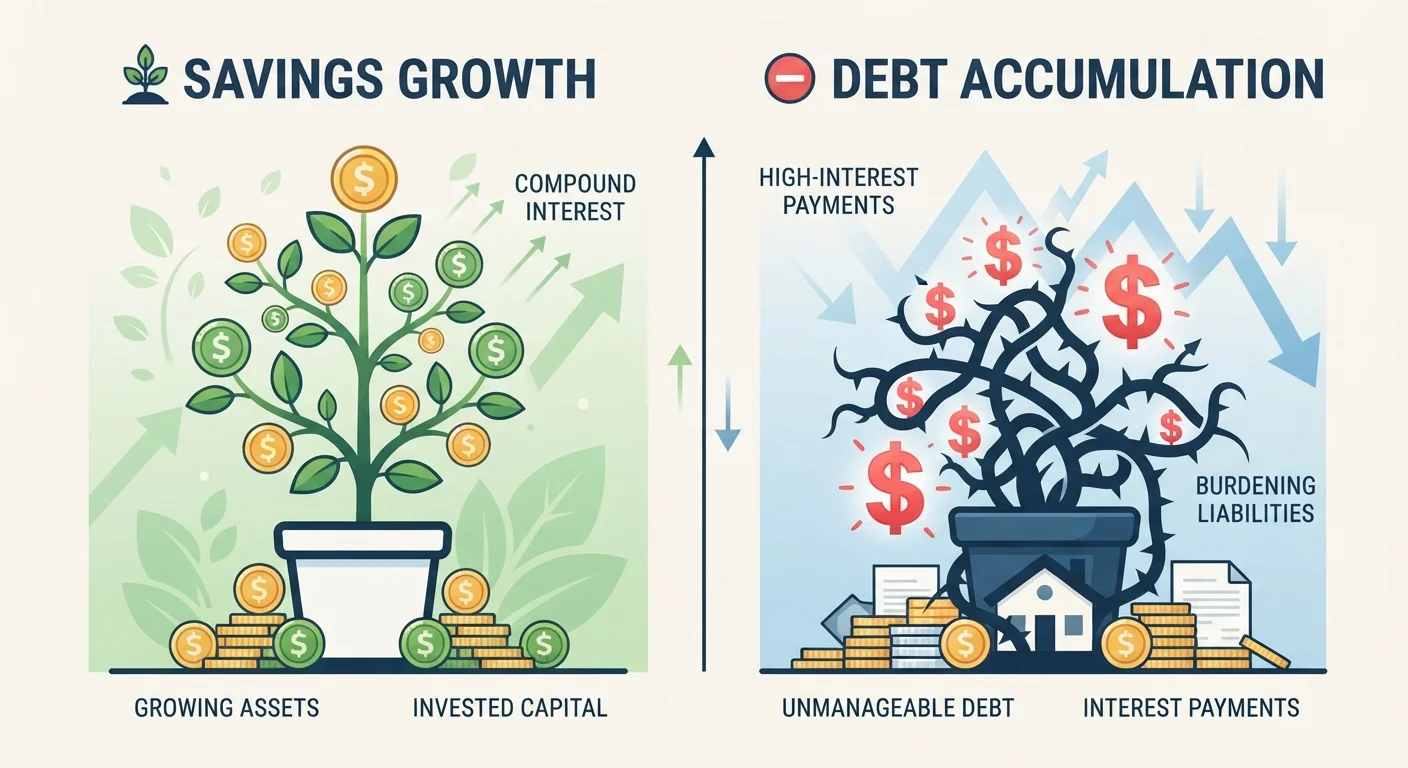
The Core Mechanic: Interest on Interest
Simple interest only ever applies to the amount you originally deposited or borrowed. Compound interest goes further: each period, earned interest is added to the principal, and the new, larger total becomes the base for the next calculation. This self-reinforcing loop is what makes compounding so powerful - for better and worse.
Consider $5,000 in a savings account earning 5% annual interest, compounded annually. After year one, you have $5,250. In year two, interest accrues on $5,250 - not the original $5,000 - producing $5,512.50. After 20 years without adding another dollar, that balance reaches roughly $13,266. Simple interest at the same rate would produce only $10,000. The difference is entirely compounding.
APY vs. APR: Know the Difference
Annual Percentage Yield (APY) reflects what you actually earn on savings after compounding is included - it's always equal to or higher than the stated interest rate. Annual Percentage Rate (APR) is what lenders quote for debt, but because most debt compounds more frequently than once a year, the true cost can exceed the stated APR. Always compare APY to APY and APR to APR when evaluating financial products.
When Compounding Works For You: Savings and Investments
Savings accounts, money market accounts, and retirement accounts like 401(k)s and IRAs all use compounding to grow balances over time. The three variables that determine how much your money grows are the interest rate, the compounding frequency, and - most critically - time.
Because of time's outsized role, starting earlier matters more than starting with a large amount. Someone who contributes consistently from age 25 can end up with significantly more than someone who contributes the same total amount starting at 35, purely due to the extra compounding periods. This is why financial planning guidance consistently emphasizes building an emergency fund and contributing to retirement accounts as early as possible.
~$13,266
Value of $5,000 after 20 years at 5% compounded annually
Compared to $10,000 under simple interest - a difference created entirely by compounding on accumulated interest.
20%-30%+
Typical credit card APR range in the U.S.
Federal Reserve data consistently shows average credit card interest rates well above most savings yields, making unpaid balances costly to maintain.
72 ÷ rate
Rule of 72: years to double a balance
At 24% APR, an unpaid debt balance doubles in approximately 3 years; at 6% savings return, an investment doubles in roughly 12 years.
For practical strategies that keep irregular expenses from derailing your savings momentum, see our guide to sinking funds.
When Compounding Works Against You: Debt
The same mechanic that quietly grows a retirement account also silently inflates unpaid debt. Credit card balances often compound daily - meaning the card issuer divides your APR by 365 and applies that fraction to your balance every single day. At a 24% APR, that's roughly 0.066% per day, which seems negligible until it compounds over months.
Carry a $3,000 credit card balance and make only minimum payments? Depending on the rate and minimum payment structure, you could spend years repaying and pay hundreds - sometimes thousands - more in interest than the original amount. The Consumer Financial Protection Bureau notes that carrying credit card balances is one of the most common ways households pay significantly more for purchases than the sticker price.
Target High-Interest Debt First
If you carry balances on multiple accounts, list each by interest rate. Directing extra payments to the highest-rate balance first - while making minimums on the rest - reduces the total interest compounding against you as quickly as possible. This approach is commonly called the debt avalanche method.
For a broader foundation on credit products and how interest rates are disclosed, the Credit & Banking hub covers key concepts in plain language.
Saving vs. Paying Down Debt: How to Think About the Trade-Off
One of the most common personal finance questions is whether to prioritize saving or aggressively paying off debt. Compounding helps frame the answer: compare the interest rate you're paying on debt to the rate you could realistically earn on savings.
If your credit card charges 22% APR and a high-yield savings account offers 4-5% APY, every dollar applied to that debt delivers an effective, guaranteed return equivalent to avoiding a 22% charge. Savings, by contrast, offer no guarantee of future returns and carry risk in many investment vehicles. For most high-interest consumer debt, paying it down is the mathematically stronger move - though maintaining a small emergency fund first is widely recommended so that unexpected costs don't immediately push you back into debt.
Low-interest debt - such as certain federal student loans or fixed-rate mortgages - presents a closer call. The spread between the debt rate and potential investment returns may be narrow enough that contributing to a tax-advantaged retirement account simultaneously makes sense. These decisions depend heavily on individual circumstances, and a licensed financial adviser can help evaluate the right balance for your situation.
This article is for general informational and educational purposes only and does not constitute personalized financial, investment, tax, or legal advice. Consult a qualified financial professional before making decisions about your own savings or debt repayment strategy.