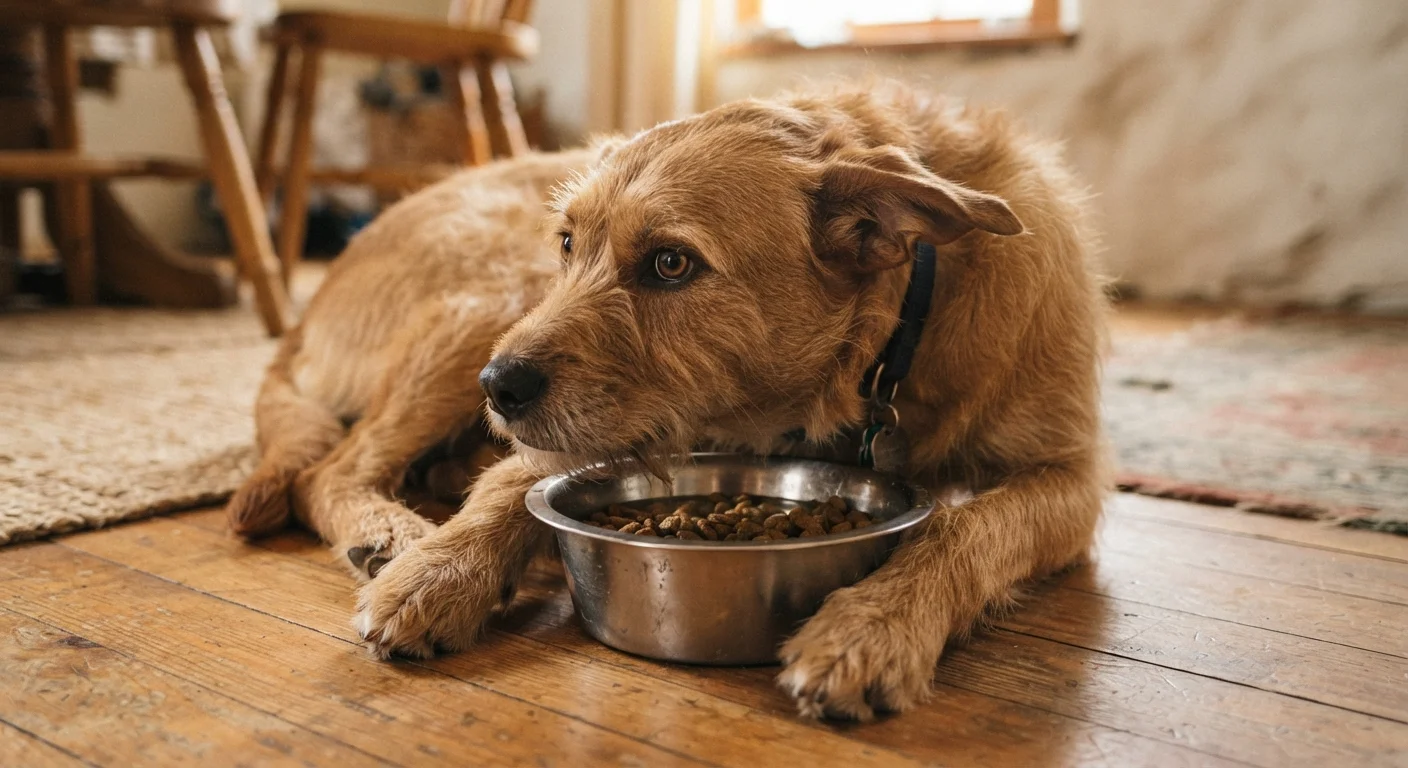
What Resource Guarding Actually Looks Like
Resource guarding can be easy to miss in its early stages. A dog might simply freeze when you walk past its bowl, hover over a chew toy, or eat faster when someone approaches. These subtle signals often precede the more obvious ones - a hard stare, a low growl, a raised lip, or eventually a snap.
What dogs guard varies widely. Food and high-value chews are the most common triggers, but dogs also guard toys, resting spots like beds or couches, water bowls, stolen items, and sometimes even specific people. The common thread is perceived value: the dog has decided this resource matters and that keeping it requires active defense.
Understanding the full picture of a dog's guarding behavior means looking at context. Does it happen only with certain people? Only in specific locations? Only with high-value items? These details matter enormously when assessing severity and planning a response. For a deeper look at why these patterns repeat, see our article on what drives repeated problem behaviors.
Keep a Guarding Log Before You Act
Before attempting any modification, spend one to two weeks noting every guarding incident: what was guarded, who triggered it, the dog's exact signals, and what happened next. This record helps you identify patterns, gauge severity, and gives a professional the clearest possible starting point. Avoid relying on memory alone - small details often matter.
The Science Behind the Behavior
Resource guarding has clear evolutionary roots. Wild canids that successfully defended food were more likely to survive and reproduce. Modern domestic dogs retain this behavioral tendency even though most of them will never face actual food scarcity. The behavior is wired in - not a moral failing.
Behavioral science frames resource guarding through the lens of associative learning. A dog learns that when a person approaches its bowl, something unpleasant may happen - the food disappears, the item gets taken away. Over time, approach becomes a predictor of loss, and the dog responds with increasing anxiety and defensive behavior. Punishment during guarding episodes reinforces this negative association and typically escalates the behavior rather than reducing it.
“The growl is a gift. It is the dog's way of saying 'I'm uncomfortable' before escalating. Teaching a dog not to growl is like removing the batteries from a smoke alarm.”
— Jean Donaldson, Certified Applied Animal Behaviorist and author of 'Mine! A Practical Guide to Resource Guarding in Dogs'
This is why the instinct to correct a growling dog - by scolding or physically removing the resource - is counterproductive. The growl is the dog's last verbal warning before escalating. Suppress the warning without changing the underlying emotion, and the dog may skip straight to biting in future encounters.
A Spectrum of Severity - and Why It Matters
Not all resource guarding is the same, and treating mild guarding with the same urgency as severe guarding - or vice versa - can both waste effort and create real risk.
Behavioral professionals often describe guarding on a continuum:
- Mild: Eating faster, subtle body stiffening, moving away with the item
- Moderate: Freezing, hard stare, low growl, hovering over the resource
- Severe: Raised lip, snapping, lunging, or biting when the resource is approached
Where a dog falls on this spectrum - and whether it has escalated over time - shapes every decision about how to respond. Mild guarding in a low-risk household may be manageable with environmental changes alone. Severe guarding, especially involving snapping or biting, warrants professional assessment before any behavior modification is attempted.
Medical Causes Can Trigger Guarding
A sudden onset or sharp escalation of resource guarding in a previously unguarded dog warrants a veterinary check before behavioral intervention. Pain conditions, thyroid disorders, and neurological changes can all lower a dog's threshold for defensive behavior. Rule out medical causes first - especially in older dogs or when the change in behavior is abrupt.
It's also worth noting that guarding behavior can vary by context. A dog that guards bones but has never guarded food is a different case from one that guards all resources from all people. Careful observation - ideally documented - gives you and any professional you consult the most useful information.
What Not to Do - and Why It Matters
Common instinctive responses to resource guarding often make the problem worse. Here are approaches that behavioral science consistently advises against:
- Reaching into the bowl or taking the item by force: This confirms the dog's anxiety that approach means loss, and dramatically increases bite risk.
- Punishing growling: Removes the warning signal without changing the emotional state. The dog becomes less predictable, not less aggressive.
- Dominance-based "alpha" techniques: Rolling a dog onto its back, staring it down, or using physical correction during guarding episodes carries significant injury risk and no evidence of effectiveness for this behavior.
- Waiting it out: Resource guarding rarely resolves on its own. Without intervention, it typically remains stable or worsens, particularly as the dog practices and reinforces the behavior.
Understanding what not to do is genuinely the first step - before any active modification plan begins.
Evidence-Based Approaches: The Foundation
The two techniques with the strongest evidence base for resource guarding are counter-conditioning and desensitization, often used together.
Desensitization means gradually exposing the dog to the approach trigger at a level so low it doesn't provoke a guarding response - starting from a distance or with low-value items - then slowly decreasing that distance or increasing the value over many sessions.
Counter-conditioning pairs the approach (the trigger) with something highly positive, like a high-value treat delivered from a safe distance. Over time, the dog begins to associate approach with good things rather than threat of loss. This changes the underlying emotional state, not just the outward behavior.
These techniques require patience, consistency, and careful management of the environment between sessions. They also require an accurate baseline assessment of the dog's current threshold - the point at which guarding begins - which is where professional guidance becomes particularly valuable. For cases involving aggression, consulting a certified applied animal behaviorist or veterinary behaviorist is strongly recommended before beginning any program. Learn more about when professional help is the right call.
This article provides general behavioral information and education. It is not a substitute for professional veterinary or behavioral assessment. If your dog has snapped or bitten, or if you have safety concerns, consult a qualified professional before attempting any behavior modification.