Who Qualifies for Each Program
Medicare and Medicaid are both government health programs, but they serve different populations and operate under different rules. Getting the basics right matters - because qualifying for one doesn't automatically mean you qualify for the other.
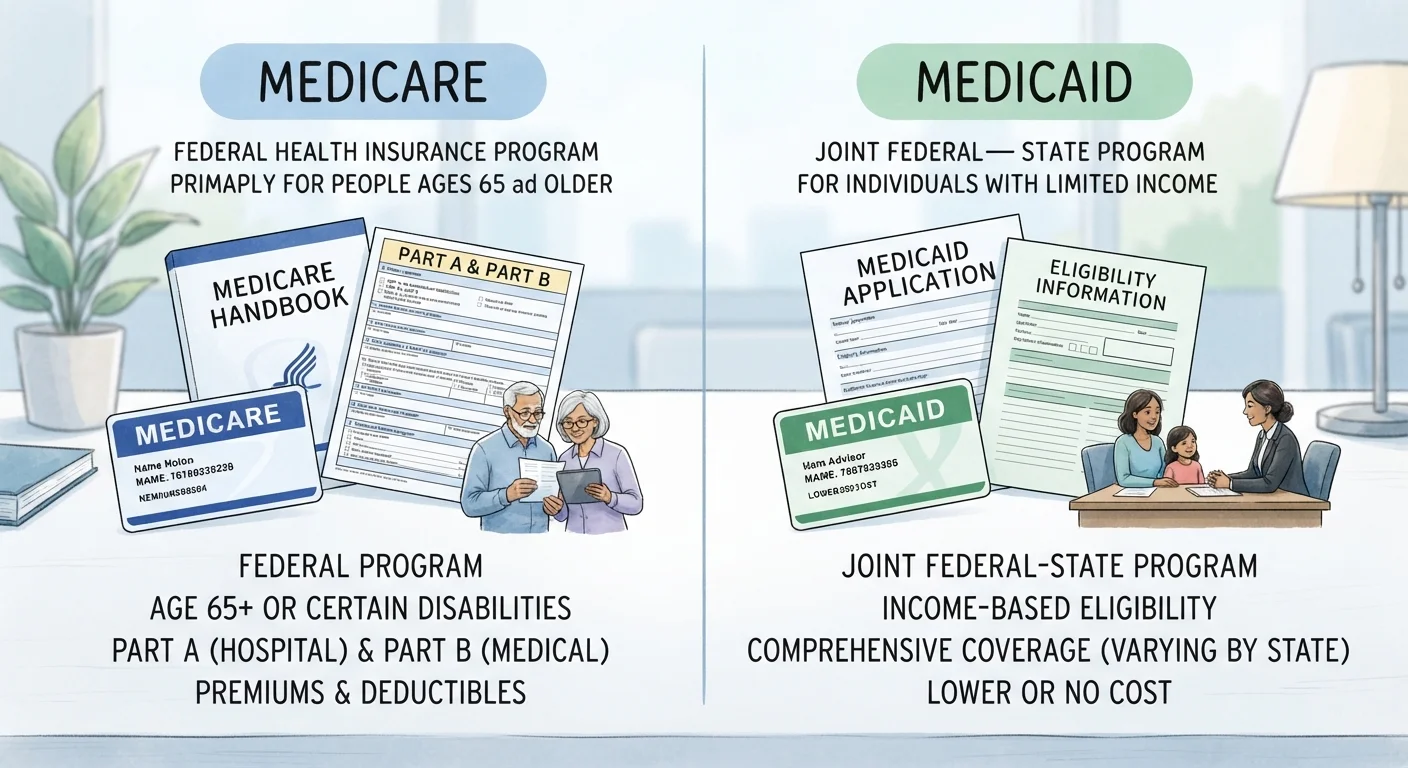
Medicare is a federal program with nationally uniform eligibility rules. You generally qualify if you are 65 or older and a U.S. citizen or permanent resident who has lived in the country for at least five years. Younger adults may also qualify if they have received Social Security Disability Insurance (SSDI) for 24 months, or if they have been diagnosed with End-Stage Renal Disease (ESRD) or Amyotrophic Lateral Sclerosis (ALS).
Medicaid eligibility works differently. It is jointly funded by the federal government and individual states, and each state sets its own income and asset limits within federal guidelines. The Affordable Care Act expanded Medicaid in participating states to cover most adults with incomes up to 138% of the federal poverty level, but not every state adopted this expansion. Children, pregnant women, and people with disabilities may qualify under different thresholds.
A Note on Program Names
Medicare and Medicaid are separate programs despite their similar names - a source of persistent confusion. Medicare is an entitlement program tied to age or disability status, while Medicaid is a means-tested assistance program tied to income. The two programs can overlap, but they operate under distinct rules. When in doubt about which applies to you, contact your state's Medicaid office or call 1-800-MEDICARE for Medicare-related questions.
For a broader look at how health coverage works before diving into specific programs, see Health Insurance Explained for a plain-language overview.
What Medicare Covers - and What It Costs
Medicare is organized into distinct parts, each covering a specific category of care.
- Part A (Hospital Insurance): Covers inpatient hospital stays, skilled nursing facility care (up to certain limits), hospice, and some home health services. Most people pay no monthly premium for Part A if they or their spouse paid Medicare taxes for at least 10 years.
- Part B (Medical Insurance): Covers outpatient care, doctor visits, preventive services, and durable medical equipment. Part B requires a monthly premium.
- Part C (Medicare Advantage): An alternative way to receive Parts A and B benefits through a private insurer approved by Medicare. Plans may include additional benefits not in original Medicare.
- Part D (Prescription Drug Coverage): Covers prescription medications. Available as a standalone plan or bundled within Medicare Advantage.
Even with Medicare, there are meaningful out-of-pocket costs - deductibles, copays, and coinsurance. Understanding how these fit together is important; for a clear explanation of those terms, see Insurance Premiums, Deductibles, and Copays.
| Criterion | Medicare | Medicaid |
|---|---|---|
| Primary eligibility basis | Age (65+) or qualifying disability | Income and household size |
| Administered by | Federal government (CMS) | Federal and state governments jointly |
| Rules vary by state? | No - nationally uniform | Yes - significantly |
| Long-term custodial care | Not generally covered | Covered (nursing home & often home-based) |
| Dental, vision, hearing | Limited under original Medicare | Varies by state |
| Prescription drugs | Covered under Part D | Covered in most states |
| Monthly premiums | Yes (Part B and often Part D) | Typically none or very low |
| Can qualify for both? | Yes - dual eligibility possible | Yes - dual eligibility possible |
What Medicaid Covers - and How It Varies by State
Medicaid is generally more comprehensive than Medicare in certain areas, particularly long-term care. It covers nursing home care and, in many states, home- and community-based services - coverage that Medicare provides only on a limited, short-term basis. This distinction is significant for families navigating aging or disability-related care needs. For more on that gap, Long-Term Care Insurance and Why It's Often Misunderstood explains what fills it.
Mandatory federal Medicaid benefits include:
- Inpatient and outpatient hospital services
- Physician services
- Laboratory and X-ray services
- Nursing facility services for adults
- Home health services
- Early and Periodic Screening, Diagnostic, and Treatment (EPSDT) services for children
States may also offer optional benefits such as prescription drugs, dental care, vision, and physical therapy. Because states have discretion here, coverage can differ considerably depending on where you live. Always check your state's Medicaid agency for specifics.
160M+
Americans enrolled in Medicaid and CHIP
As of recent CMS enrollment data, Medicaid and the Children's Health Insurance Program together cover more than 160 million Americans.
65M+
Medicare beneficiaries nationwide
The Centers for Medicare & Medicaid Services reports more than 65 million people enrolled in Medicare across all parts of the program.
~12M
Dual-eligible beneficiaries
An estimated 12 million Americans qualify for both Medicare and Medicaid simultaneously, according to CMS data.
The Gaps Both Programs Leave - and How to Plan for Them
Neither Medicare nor Medicaid is a complete safety net on its own. Medicare doesn't cover most dental, vision, or hearing care under original Parts A and B. It also doesn't cover long-term custodial care - help with daily activities like bathing or dressing - unless the person needs skilled care that meets specific criteria.
Medicaid coverage gaps depend heavily on the state. Some states cover dental and vision; others don't. Eligibility can also change if your income or household situation shifts, which means coverage is not always stable for everyone who qualifies.
People who qualify for both Medicare and Medicaid - called dual-eligible beneficiaries - often have more of their costs covered, since Medicaid may pay Medicare's premiums, deductibles, and copays. However, coordinating between two programs still requires attention to which providers accept both.
If you want to understand the broader limits of any insurance policy - not just government programs - What Insurance Actually Covers - and What It Doesn't provides a useful framework. And for anyone thinking about long-term care costs, reviewing How Coverage Limits and Caps Shape What You Receive can clarify how policy ceilings affect what you actually receive in a claim.
This article is for general informational purposes only and does not constitute personalized insurance, financial, or legal advice. Coverage rules, eligibility criteria, and benefits vary by state and individual circumstances. Consult a licensed insurance professional or your state's Medicaid agency for guidance specific to your situation.