Why Credit Report Vocabulary Matters
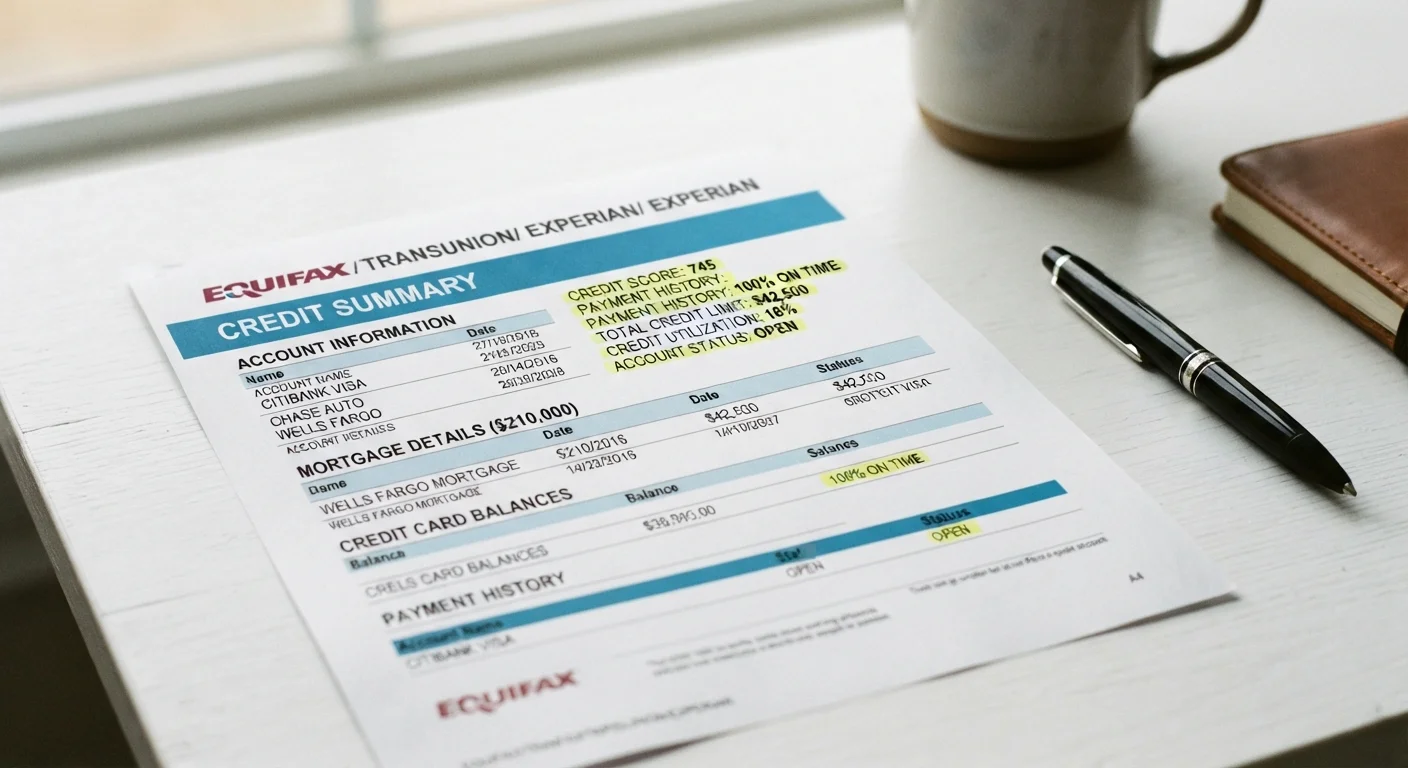
When you pull your credit report - whether from AnnualCreditReport.com or through a credit monitoring service - you're likely to encounter a wall of terminology that isn't explained anywhere on the page. Terms like derogatory mark, charge-off, and credit utilization ratio carry real weight: they directly influence whether lenders see you as a low-risk or high-risk borrower.
This reference guide defines the terms you're most likely to encounter when reviewing a credit report, organized by how they typically appear. Think of it as a decoder ring for one of the most important financial documents in your life.
This article is for general informational purposes only and does not constitute financial advice. For guidance specific to your situation, consider consulting a licensed financial professional.
| Major Credit Bureaus | Equifax, Experian, TransUnion (Consumer Financial Protection Bureau) |
| Free Annual Credit Reports | 1 per bureau per year (federally mandated) (AnnualCreditReport.com) |
| Negative Item Reporting Window | Generally 7 years; bankruptcies up to 10 years (Fair Credit Reporting Act (FCRA)) |
| Charge-Off Trigger | Typically after 180 days of non-payment (Federal Reserve guidelines) |
| Hard Inquiry Duration | Remains on report for 2 years (FCRA) |
Account and Status Terms
Most of your credit report is made up of individual tradelines - the industry term for each account listed. For every tradeline, you'll see an account status field. Here's what the most common statuses mean:
- Open: The account is active and in use.
- Closed: The account has been closed, either by you or the lender. Closed accounts can remain on your report for up to 10 years if positive, or 7 years if negative.
- Current: All payments are up to date with no missed amounts.
- Delinquent: A payment is overdue, typically by 30 days or more. Delinquency is usually reported in stages: 30, 60, 90, and 120+ days late.
- Charge-off: The lender has written the debt off as a loss after extended non-payment (usually 180 days). The debt still exists and can be sold to a collections agency. This is one of the most damaging marks on a credit report.
- In collections: A past-due debt has been transferred to a collection agency. This appears as a separate tradeline.
If you spot an account status that doesn't look right, learn what to do next in our guide on disputing credit report errors.
Tradeline
Any individual account listed on your credit report, such as a credit card, auto loan, or mortgage. Each tradeline includes the creditor's name, account status, balance, and payment history.
Credit Utilization Ratio
The percentage of your available revolving credit (like credit cards) that you're currently using. It is calculated by dividing total balances by total credit limits.
Derogatory Mark
Any negative item on a credit report - such as a late payment, charge-off, collection, or bankruptcy - that signals elevated credit risk to lenders.
Charge-Off
When a creditor declares a past-due debt unlikely to be collected and writes it off as a loss, typically after 180 days of non-payment. The debt still legally exists despite the accounting designation.
Hard Inquiry
A credit report access triggered by a formal credit application. Hard inquiries are visible to lenders, can modestly lower your credit score, and remain on your report for two years.
Soft Inquiry
A credit report access that does not affect your credit score, such as a pre-approval check, employer background check, or when you review your own report.
Account Status
A field on each tradeline indicating the current standing of that account - for example, current, delinquent, closed, or in collections.
Delinquency
A missed or late payment on a credit account. Delinquencies are typically reported in intervals of 30, 60, 90, and 120+ days and can remain on a credit report for seven years.
Credit Bureau
An agency that collects and maintains consumer credit data reported by lenders, and compiles it into credit reports. The three major U.S. bureaus are Equifax, Experian, and TransUnion.
Public Record
A legal or financial event - such as a bankruptcy - recorded in court documents and reportable on your credit file. Bankruptcies can remain on a credit report for 7 to 10 years.
Utilization, Inquiries, and Public Records
Beyond account statuses, three other areas of your credit report deserve close attention:
Credit Utilization
Your credit utilization ratio is the percentage of your total revolving credit limit that you're currently using. For example, if your combined credit card limits total $10,000 and your balances total $3,000, your utilization is 30%. Most credit scoring models treat lower utilization favorably. For a deeper look, see how credit utilization is calculated and why small percentages matter.
Inquiries
Every time someone accesses your credit report, it's recorded as an inquiry. There are two types:
- Hard inquiry (hard pull): Triggered when you apply for credit - a loan, credit card, or mortgage. Hard inquiries can temporarily lower your score by a few points and remain on your report for two years.
- Soft inquiry (soft pull): Triggered by background checks, pre-approval screenings, or when you check your own credit. Soft inquiries do not affect your credit score.
Public Records
Historically, public records sections included bankruptcies, civil judgments, and tax liens. As of a major update by the national credit bureaus, tax liens and civil judgments were removed from credit reports. Bankruptcies remain and can stay on your report for 7 to 10 years, depending on the type filed.
Your Report and Your Score Are Not the Same
A credit report is a detailed record of your borrowing history; a credit score is a numerical summary calculated from that data using a scoring model (such as FICO or VantageScore). Lenders may check either or both. Reviewing your report regularly helps you catch errors that could drag your score down without your knowledge.
For a broader financial vocabulary reference, see key debt and savings terms and our budgeting glossary.