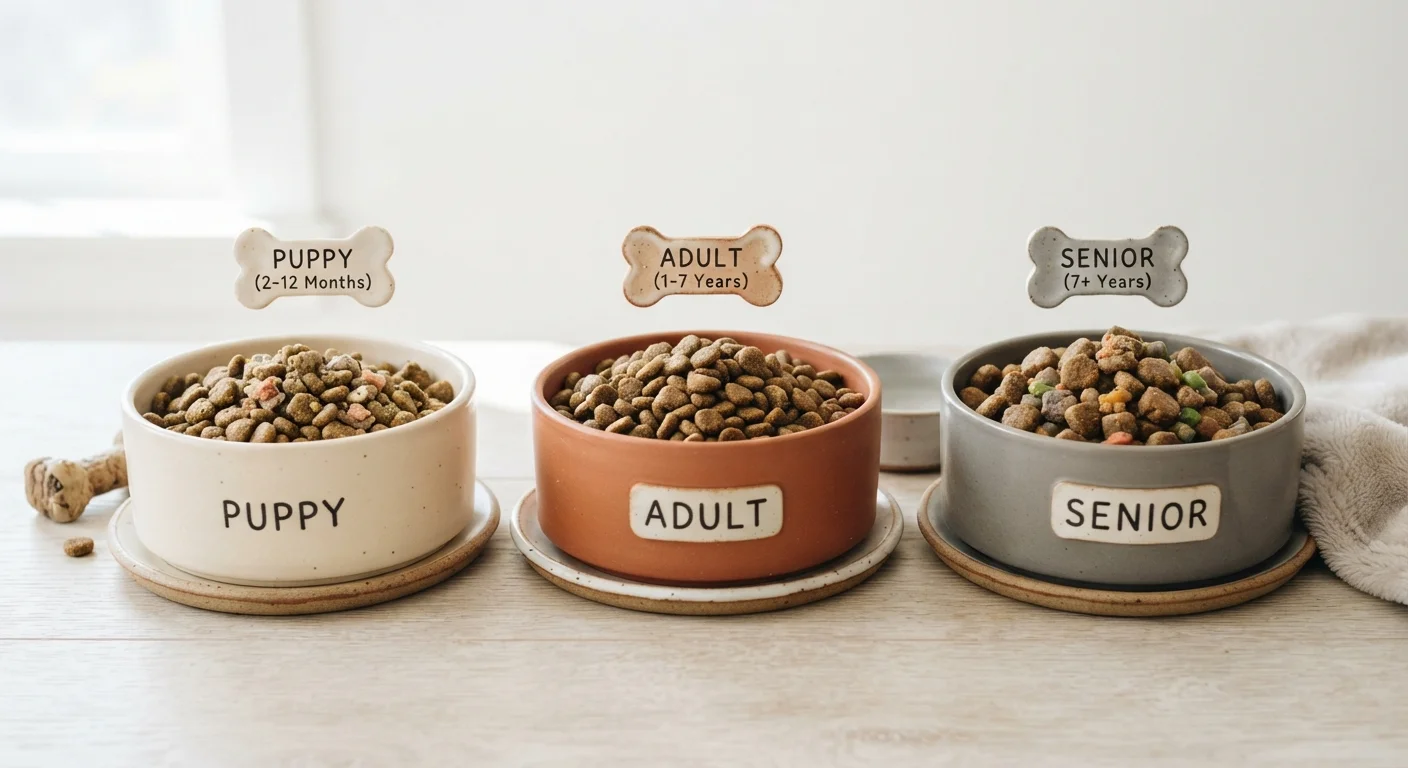
What AAFCO Labels Actually Mean
Every commercially sold pet food in the United States is expected to carry a nutritional adequacy statement - a short line of text, often near the ingredient list, that explains what the food is designed to do. These statements are based on standards set by the AAFCO, an organization that publishes nutrient profiles for dogs and cats.
Two phrases appear most often on these labels:
- "Formulated to meet the nutritional levels established by the AAFCO Food Nutrient Profiles for " - meaning the formula was designed on paper to hit specific targets.
- "Animal feeding tests using AAFCO procedures substantiate that provides complete and balanced nutrition for " - meaning the food was actually fed to animals and monitored for health outcomes.
The life stage declared in that statement is what distinguishes a life-stage-specific food from an all life stages formula. Understanding what each covers helps you read labels with confidence rather than guessing.
| All Life Stages | Life-Stage-Specific | |
|---|---|---|
| AAFCO basis | Meets highest nutrient minimums across all categories | Calibrated to one life stage's nutrient profile |
| Best suited for | Puppies, kittens, pregnant/nursing pets, multi-pet homes | Healthy adults, or seniors with specific needs |
| Nutrient levels | Higher floors to cover growth and reproduction | Tailored minimums for maintenance or a defined stage |
| Large-breed puppy suitability | Only if explicitly stated on label | Varies; check for large-breed designation |
| Senior pet suitability | Usable but may not address age-related adjustments | May be better calibrated, but no AAFCO senior standard exists |
| Label transparency | Clear AAFCO statement covering all stages | Marketing labels (e.g. 'senior') vary widely by brand |
All Life Stages: High Floors, Broad Coverage
A food labeled for "all life stages" must meet the most demanding nutritional minimums across every AAFCO category simultaneously. Because puppies and kittens - along with pregnant and nursing animals - have the highest requirements for protein, calcium, phosphorus, and certain vitamins, an all life stages formula is essentially built to satisfy those elevated thresholds.
This has a practical upside: an all life stages food is genuinely adequate for a puppy or a pregnant dog without any reformulation. In a household where a nursing mother and her puppies are eating from the same bowl, this label matters.
Check the Full Adequacy Statement
Don't rely on front-of-bag claims like 'for all ages' alone. Flip to the back and find the nutritional adequacy statement - it will name the specific life stage the formula is substantiated for. This is the most reliable single piece of information on the package. If the statement says 'adult maintenance,' it is not formulated for puppies, regardless of how the product is marketed.
The tradeoff is that what benefits a growing puppy may not be ideal for every adult. For example, large- and giant-breed puppies often do better on foods with controlled calcium-to-phosphorus ratios to support steady skeletal development - and not every all life stages formula is formulated with that in mind. Check whether the label explicitly mentions large-breed puppies if that applies to your dog.
For adult pets in normal maintenance, consuming a food with nutrient levels calibrated for growth is generally not harmful, but it may mean slightly more of certain nutrients than needed. Whether that matters in practice depends on the individual animal and, ultimately, your vet's assessment.
Life-Stage-Specific Foods: Precision Over Breadth
Foods labeled for a specific life stage - "adult maintenance," "growth," or "senior" - are formulated to hit a narrower nutritional target. An adult maintenance formula is designed for healthy, non-reproducing animals past their growth phase. It doesn't need to meet the higher minimums required for growth, so manufacturers have more flexibility to calibrate nutrient levels more tightly.
This can be meaningful for certain nutrients. Phosphorus, for instance, is a nutrient that aging kidneys may process less efficiently. A food explicitly formulated for seniors may carry lower phosphorus levels than an all life stages product - a relevant distinction for older pets. For more on how nutrient priorities shift with age, see our guide to senior pet nutrition.
It's worth noting that AAFCO does not currently publish a separate nutrient profile specifically for "senior" pets - that label is used commercially but is not tied to a distinct regulatory standard the way "growth" or "adult maintenance" are. This means senior formulas can vary considerably between manufacturers. Always look at the full nutritional adequacy statement, not just the marketing language on the front of the bag.
The 'Senior' Label Has No Regulatory Standard
Unlike 'growth' or 'adult maintenance,' the term 'senior' on pet food packaging is not tied to a specific AAFCO nutrient profile. This means two products both labeled 'senior' may have meaningfully different formulations. Scrutinize the actual nutritional adequacy statement and, where possible, discuss the specific food with your veterinarian before transitioning an older pet.
For context on how life-stage nutrition parallels human dietary science, our overview of nutrition across a human lifetime explores similar concepts.
Applying This in Real Life
When choosing between these two approaches, start with your pet's current life stage and health status, not the packaging design.
- Puppies and kittens: Look for a food labeled for growth or all life stages. Large-breed puppies specifically benefit from formulas that note large-breed suitability.
- Healthy adult pets: An adult maintenance formula is calibrated for their actual needs. An all life stages food is also fine, though it may carry higher nutrient levels than strictly necessary.
- Pregnant or nursing pets: AAFCO recommends foods labeled for all life stages or growth during gestation and lactation - these are the highest-demand periods nutritionally.
- Senior pets: This group benefits most from a veterinary conversation. As our senior pet care guide explains, aging animals have shifting needs that go beyond nutrition alone. What counts as appropriate for one senior dog may differ for another based on kidney function, weight, and mobility.
Keep in mind that the label format (dry vs. wet) is a separate question from life stage suitability. Our dry food vs. wet food comparison covers how moisture content and calorie density factor into the overall feeding picture.
This article is for general informational and educational purposes only. It is not a substitute for professional veterinary advice. Always consult a licensed veterinarian before making significant changes to your pet's diet, especially if your pet has an existing health condition.