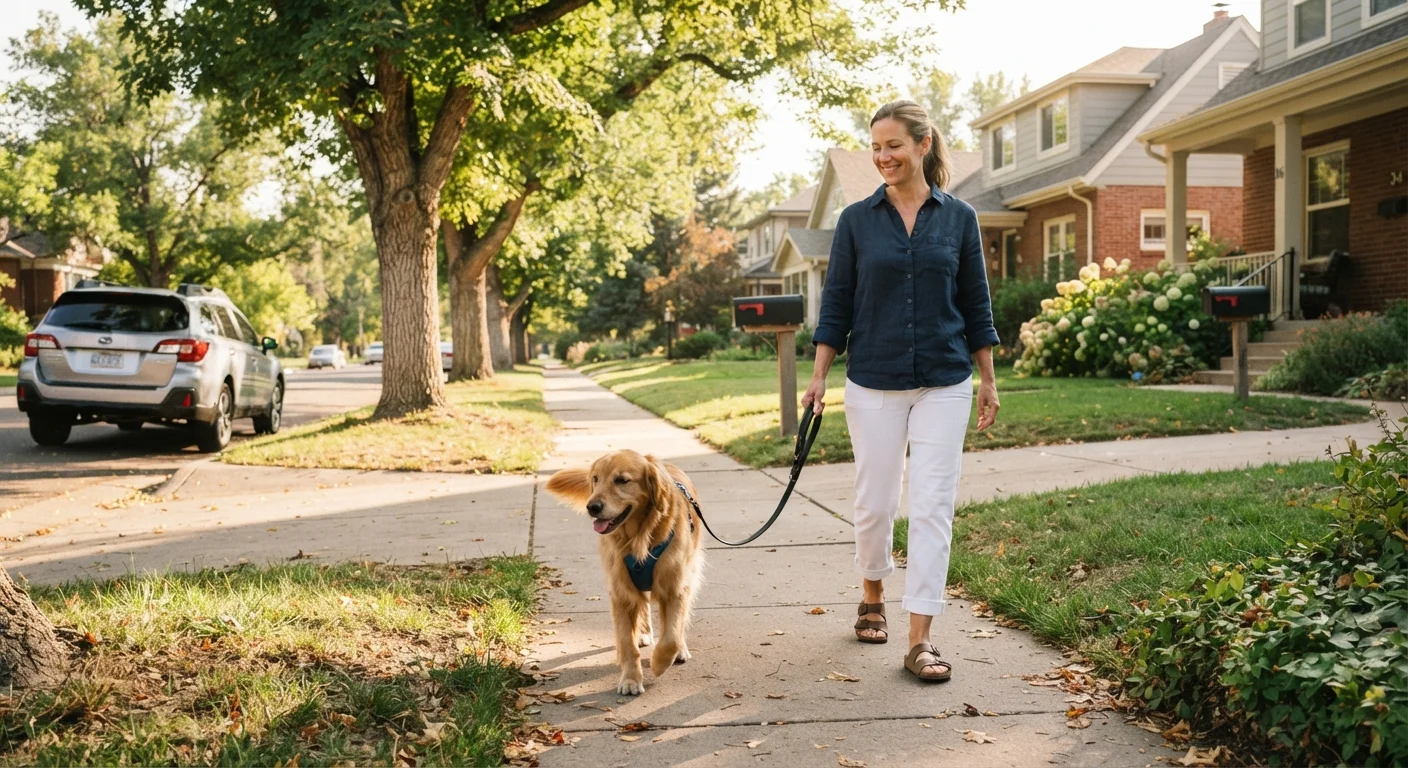
Why Dogs Pull - and Why Scolding Alone Doesn't Fix It
Leash pulling is one of the most reported frustrations among dog owners, and it is also one of the most misunderstood. Dogs do not pull because they are dominant, stubborn, or disrespectful. They pull because pulling has worked. Every time a dog lunges toward a smell or another dog and reaches it - even momentarily - the behavior is reinforced. The leash itself becomes irrelevant to the dog because the environment rewards the pulling regardless of what you do afterward.
To understand the full cycle, it helps to read about why pets repeat unwanted behaviors - the behavioral science that explains why scolding after the fact rarely changes anything. What matters is what happens in the moment the behavior occurs.
Loose-leash walking is not about dominance or control - it is about teaching your dog a clear, consistent rule: a slack leash keeps the walk moving; a tight leash stops it. Once the dog understands that rule and trusts it to be reliable, pulling loses its value.
Retractable Leashes Undermine This Training
Retractable leashes teach dogs that pulling extends their range - which is the opposite of what loose-leash training requires. While working through this process, use only a fixed-length leash of four to six feet. Once reliable leash manners are established, you can evaluate whether a retractable leash is appropriate for specific low-distraction contexts.
What You Need Before You Begin
Setting yourself up correctly before the first training walk makes a significant difference in how quickly you progress. The right equipment removes mechanical disadvantages; the right environment removes distractions that would otherwise overwhelm your dog's ability to learn.
What you will need
Front-Clip Harness
Redirects the dog toward you when it pulls forward, reducing pulling force without causing discomfort.
Standard 4-6 Foot Leash
Provides a fixed, predictable range that helps you communicate boundaries clearly - avoid retractable leashes during training.
High-Value Training Treats
Motivates attention and compliance; should be small, soft, and reserved exclusively for training to maintain their value.
Treat Pouch
Keeps rewards immediately accessible so you can reinforce the correct behavior within the critical one-to-two second window.
Clicker
Provides a precise, consistent marker sound that signals to the dog the exact moment it earned a reward.
For guidance on structuring sessions so your dog is in the best position to learn - including how long to train, when to train, and where to begin - see how to set up training sessions that actually work.
Step-by-Step: Teaching the Loose-Leash Habit
The following steps follow a progressive structure - each one builds on the last. Resist the urge to skip ahead. Dogs that seem to "already know" the early steps often benefit from a few refresher sessions that lock in the foundational understanding before distractions are introduced.
Load your marker cue before going outside
Before working on leash manners, your dog needs to understand what "yes" means. Spend one or two indoor sessions clicking (or saying "yes") and immediately delivering a treat, 10-15 repetitions at a time. The marker has no meaning on its own at first - repetition creates the association. Once your dog's ears perk or it looks at you every time it hears the marker, the cue is loaded and you are ready to use it outdoors.
Practice attention in a zero-distraction environment
Stand still in your backyard or a quiet hallway with your dog on leash. Wait. The moment your dog makes eye contact with you - without being prompted - mark and treat. Repeat until your dog is checking in with you frequently and voluntarily. This "check-in" behavior becomes the foundation of loose-leash walking: a dog that notices you is a dog that can walk with you.
Introduce the "penalty yards" rule
Clip the leash and begin walking. The moment the leash goes taut - stop completely. Do not pull back, do not say anything. Simply become a statue. Wait for your dog to release the pressure by stepping back toward you or turning to look at you. The instant the leash goes slack, mark and take a few steps forward as the reward. Forward movement is what the dog wants; it must learn that a loose leash is what unlocks it.
Reward position, not just absence of pulling
Once your dog understands stop-and-start, begin actively rewarding it for walking near your side with a slack leash. Hold a treat at your hip or thigh level; when your dog is in the right zone, drop the treat straight down so it is rewarded in position. Over time, fade the lure so the dog is seeking the position on its own rather than following a treat in your hand.
Gradually increase distraction level
Once your dog walks reliably on a slack leash in a quiet area, move to a slightly busier environment - a neighborhood sidewalk with occasional foot traffic, for example. Each new environment is essentially a new training session, so lower your expectations temporarily and be generous with reinforcement. Progress looks like a staircase, not a straight line. If your dog struggles significantly in a new setting, it is a signal to return to an easier environment and build more reps before advancing.
Build in sniff breaks as earned rewards
Dogs gather enormous amounts of information through scent, and denying them the ability to sniff creates frustration that can undermine your training. Rather than trying to keep your dog focused at all times, designate specific moments - "go sniff" - where you allow free exploration on a loose leash. When the break is over, use a cue like "let's go" to re-engage the walk. Sniff breaks work as powerful, naturally motivating rewards for sustained loose-leash behavior.
Inconsistency Is the Most Common Reason Training Stalls
If pulling is allowed on some walks but corrected on others, your dog learns that pulling sometimes works - which actually makes the behavior harder to extinguish. Every person who walks your dog must apply the same rules on every walk, including low-energy days when stopping feels tedious. A week of inconsistent practice can undo days of good progress.
Track Progress Week by Week
Keep a simple log noting how many times you stopped per walk and how quickly your dog released the leash tension. Most owners who track this objectively are surprised to see improvement emerging within the first week. Tracking also helps you spot which environments or times of day are most challenging so you can plan training accordingly.
Maintaining Progress and Setting Realistic Expectations
Most dogs do not develop reliable loose-leash walking in a single week. Expect a gradual curve - some days will feel like regression, especially when you move to new environments or encounter unexpected distractions. This is normal. The behavioral principles behind habit change apply to dogs just as they do to humans: new behaviors compete with well-practiced old ones, and the old pattern will resurface under stress until the new one is truly durable.
Walking regularly also contributes to your dog's broader health and wellbeing. Incorporating walk quality into your overall care routine is worth tracking - the monthly pet health maintenance checklist is a useful tool for monitoring behavioral changes alongside physical health between vet visits.
If your dog's pulling is accompanied by reactivity toward other dogs, people, or vehicles - lunging, barking, or extreme fixation - that pattern may benefit from a separate, dedicated behavior modification approach. Similarly, if anxiety seems to be driving your dog's behavior on walks, understanding anxiety-driven behaviors can help you distinguish between a dog that needs more training and one that needs additional support. Consulting a certified professional dog trainer or veterinary behaviorist is always a reasonable step when progress stalls.
This article is for general educational purposes and does not constitute professional veterinary or behavioral advice. If your dog displays signs of fear, aggression, or significant anxiety, consult a qualified veterinary professional or certified applied animal behaviorist.