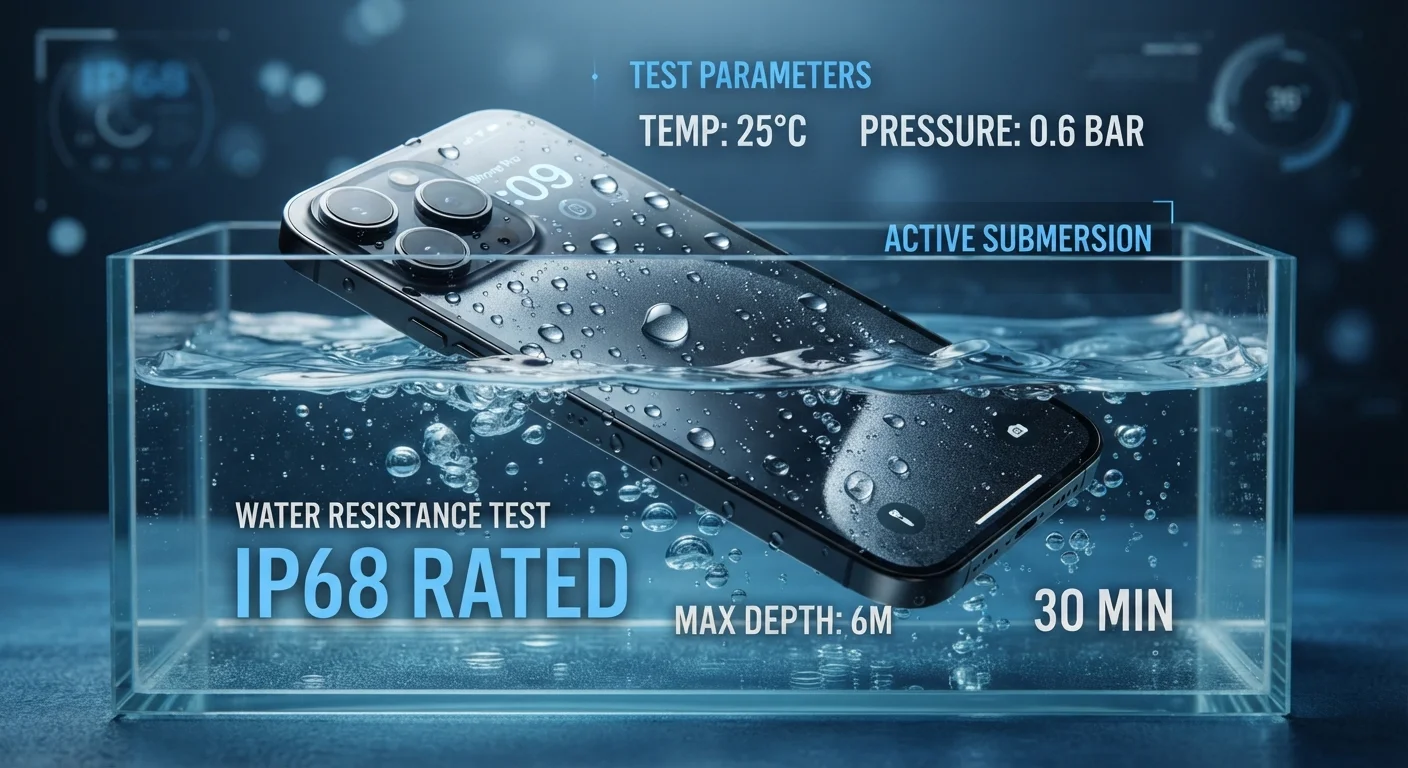
How to Read an IP Code
The letters 'IP' stand for Ingress Protection. What follows is a two-digit code. The first digit rates solid particle protection on a scale of 0 to 6. The second digit rates liquid protection on a scale of 0 to 9K. A rating of IP67, for example, means: fully dust-tight (6) and able to withstand submersion in up to 1 meter of fresh water for 30 minutes (7).
When you see an X in place of a digit - such as IPX4 - it means that characteristic was simply not tested. It is not a claim of zero protection; it is an absence of data. Marketers sometimes use this ambiguity to their advantage, so it is worth knowing the difference.
The liquid protection scale is worth memorizing in rough terms:
- 1-3: Dripping, spraying, or misting - minimal water contact
- 4: Splashing from any direction - sweat, light rain
- 5-6: Water jets and powerful jets
- 7: Immersion up to 1 meter for 30 minutes
- 8: Submersion beyond 1 meter, depth and duration set by the manufacturer
- 9K: High-pressure, high-temperature water jets
For a broader glossary of electronics spec terms, see the electronics spec sheet glossary.
The 'X' Does Not Mean Zero Protection
A rating of IPX4 means liquid protection was tested (at the splash level) but solid particle protection was not evaluated. It does not mean the device has no dust protection - it simply means no test was submitted for that category. If dust ingress matters for your use case, look for a device with a solid-digit first character, ideally a 5 or 6.
What the Rating Does Not Cover
This is where most consumer confusion lives. IP ratings are pass/fail lab results under tightly controlled conditions - typically static fresh water at a specific temperature and pressure. Real-world water exposure is rarely that clean or controlled.
The standard does not account for:
- Salt water or chlorinated water - both are more corrosive than fresh water and are not part of IP liquid tests
- High water pressure - a showerhead or faucet can exceed the pressure assumed in rating tests
- Physical damage - a cracked screen or worn gasket can compromise a previously valid rating
- Temperature variation - hot showers create steam and pressure differentials not modeled in standard tests
This is also why virtually no manufacturer covers water damage under warranty on rated devices. The rating certifies a test was passed, not that the device will survive every wet scenario you encounter. As the marketing claims guide explains, packaging language often implies more than the underlying standard actually guarantees.
Check the Exact IP68 Specification
IP68 is the only liquid-protection level where the manufacturer sets the specific depth and duration. Two devices can both carry IP68 ratings but one may be tested to 1.5 meters and another to 6 meters. Always look for the manufacturer's published submersion specification - not just the two-character code - when comparing devices rated IP68.
MIL-SPEC Labels: What They Mean in Practice
You will often see 'MIL-SPEC' or 'MIL-STD-810' on rugged phones, tablets, and laptops. MIL-STD-810 is a U.S. Department of Defense testing framework covering environmental stresses: shock, vibration, humidity, altitude, temperature extremes, and more. There are over two dozen individual test methods within the standard.
Here is the critical detail: manufacturers choose which tests to run. A device labeled MIL-STD-810 compliant may have passed only three of those test methods. There is no minimum set required, and the label itself does not specify which tests were conducted unless you dig into the product documentation. 'MIL-SPEC' on a box is a starting point for questions, not a finish line for durability confidence.
29+
Individual test methods within MIL-STD-810
The U.S. Department of Defense's MIL-STD-810 standard contains more than two dozen distinct environmental test methods, and manufacturers are not required to pass all of them to use the label.
1 m / 30 min
IP67 liquid test conditions
The IEC 60529 standard specifies that IP67 certification requires submersion in up to 1 meter of fresh water for a duration of 30 minutes under controlled laboratory conditions.
If durability is a priority for your use case, look for devices where the manufacturer publishes the specific MIL-STD-810 test methods passed, rather than a blanket label. This level of transparency is a reasonable expectation and a meaningful differentiator.
Using Ratings as One Input Among Several
IP and MIL-SPEC ratings are useful benchmarks, but they should be one factor in a broader evaluation - not the deciding one. Seals and gaskets are physical components that degrade over time with heat, UV exposure, drops, and cleaning chemicals. A device rated IP67 at manufacture may offer meaningfully less protection after 18 months of regular use.
When evaluating a device's durability for your actual environment, consider asking:
- What specific depth and duration does the manufacturer claim for IP68, if listed?
- Are repair or seal-replacement options available if the device is dropped?
- What does the warranty actually cover, in writing, regarding liquid exposure?
- Does the device have an open port (headphone jack, SIM tray) that creates a natural ingress point?
For a structured way to approach these questions across all device characteristics, see questions to ask before deciding any device fits your needs. And if you are building foundational knowledge before your first purchase, electronics literacy for first-time buyers covers the broader spec landscape in accessible terms.