The Gap Between the Box and the Bench
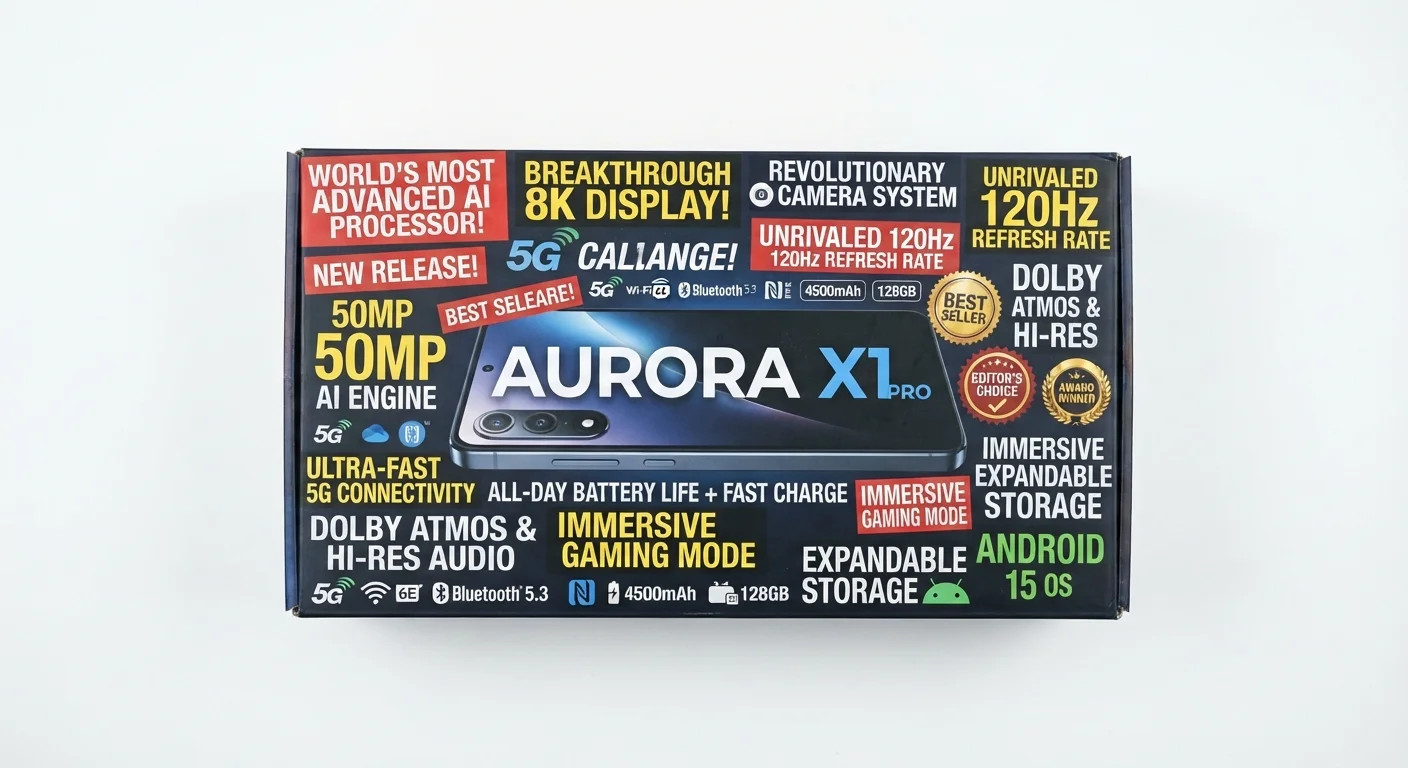
Walk down any electronics aisle and you'll be bombarded: "Up to 36-hour battery life." "8K-ready." "AI-powered performance." These phrases are engineered to impress - not to inform. That's not an accusation; it's simply how retail packaging works. The goal is to differentiate a product in two seconds of shelf time, not to deliver a balanced engineering assessment.
The problem is that most shoppers treat these claims as objective descriptions. They aren't. Nearly every bold number or buzzword on a box carries conditions, caveats, or definitions that only appear in the fine print - if they appear at all. Building the habit of asking "compared to what, and under what conditions?" is the starting point for real product literacy. If you're newer to reading specs in general, the Electronics Literacy for First-Time Buyers guide covers foundational concepts worth knowing first.
Common Claims, Decoded
The myths below represent the most frequently misread language on consumer electronics packaging. Each one sounds like a hard fact. Each one requires context to be useful.
Myth
"Up to X hours of battery life" means the device will typically last that long on a charge.
Fact
"Up to" figures represent best-case lab conditions - usually low screen brightness, minimal connectivity, and light workloads - not typical usage.
Battery life claims are measured under controlled conditions defined by the manufacturer, which rarely match how people actually use a device. Streaming video, running multiple apps, or keeping Bluetooth active can reduce real-world battery life to 50-70% of the advertised figure. The only reliable battery benchmarks come from independent reviewers testing under standardized, real-world conditions.
Myth
"AI-enhanced" or "AI-powered" means a device uses sophisticated, on-device artificial intelligence to improve performance.
Fact
"AI" is an unregulated marketing term. It may describe anything from basic algorithmic processing to a dedicated neural processing chip - there is no industry-standard definition enforced on packaging.
Some devices labeled "AI-powered" do include dedicated hardware - called a neural processing unit or NPU - that handles specific tasks like image processing or voice recognition more efficiently. Others apply the label to simple software filters or cloud-based processing that has existed for years under different names. To evaluate the claim, look for specifics: what tasks does the AI handle, and does independent testing confirm a measurable benefit?
Myth
A higher megapixel count on a camera means better photos.
Fact
Image quality depends on sensor size, lens quality, and image processing - all factors that megapixel count does not describe.
A 50-megapixel sensor crammed into a small phone module may produce noisier, lower-quality images in real conditions than a well-engineered 12-megapixel camera with a larger sensor and better optics. Megapixels measure resolution - the number of pixels captured - not sharpness, color accuracy, low-light performance, or dynamic range. This is a textbook example of spec inflation. See why higher numbers don't always mean better performance for more examples across other spec categories.
Myth
"Next-generation" or "latest-generation" processor means a meaningfully faster device.
Fact
Generation labels indicate a product cycle, not a guaranteed performance improvement. Some generational updates are incremental; others are substantial.
Chip generations are numbered sequentially, but the performance difference between adjacent generations varies widely depending on the manufacturer's design goals. Some cycles prioritize power efficiency over raw speed; others focus on new capability additions rather than processing gains. How generational upgrades in electronics actually work is a useful read for calibrating expectations before treating "new generation" as a meaningful differentiator.
Myth
"4K-capable" or "8K-ready" means the device delivers that resolution in normal use.
Fact
Capability claims describe a technical maximum under specific conditions, not the default or typical output.
A TV advertised as "8K-ready" may technically accept an 8K input signal, but commercially available 8K content remains extremely limited. A laptop described as "4K-capable" may only sustain that output when connected to power, not on battery. Reading a capability claim requires asking: capable under what conditions, using what content sources, and at what cost to other performance metrics like battery life or thermal output?
It's worth noting that this pattern isn't unique to electronics. Beauty marketing operates the same way - phrases like "clinically tested" carry similar vagueness in a different aisle.
What the Box Won't Tell You
Some of the most consequential specs are never mentioned on packaging at all. Software support lifespan - meaning how long a device will receive security patches and OS updates - directly affects how long that device remains safe and functional. A phone with impressive hardware running unpatched software within two years of purchase is a liability, not a bargain. The full breakdown of software support cycles explains how to factor this in.
Similarly, durability ratings like IP67 or MIL-SPEC sound definitive but describe specific lab tests, not general ruggedness guarantees. Understanding what IP ratings actually certify prevents a common and costly misreading.
Don't Assume Ratings Cover Real-World Drops
Durability certifications like IP water resistance or MIL-SPEC drop ratings are conducted under controlled lab conditions. IP ratings, for example, test submersion in still, clean water - not a splash from a sink or a drop in a pool. These ratings inform but do not guarantee real-world survival. Warranties also typically exclude liquid damage even on rated devices, so review coverage terms carefully.
How to Evaluate Claims on Merit
The practical antidote to marketing language is triangulation: never rely solely on the box. Cross-reference spec claims with independent reviews that test under real-world conditions. Look for teardowns or lab tests when durability or performance is central to your decision. When a number seems remarkable - like battery life that doubles the competition - treat it as a prompt to investigate, not a reason to buy.
Also watch for spec inflation: the assumption that a higher number always means a better experience. It often doesn't. Higher numbers don't always mean better performance - megapixels, processor clock speeds, and mAh ratings are all classic examples where context determines value. And before any final decision, a structured checklist can help ensure nothing important slips through: see questions to ask before deciding any device fits your needs.
Marketing Language Is Not a Substitute for Specs
Phrases like "premium," "professional-grade," and "studio-quality" have no technical definition and cannot be verified. When packaging relies heavily on descriptive adjectives rather than measurable specifications, that is a signal to seek an independent review before making a decision. Concrete specs - with units and test conditions - are always more useful than qualitative marketing language.