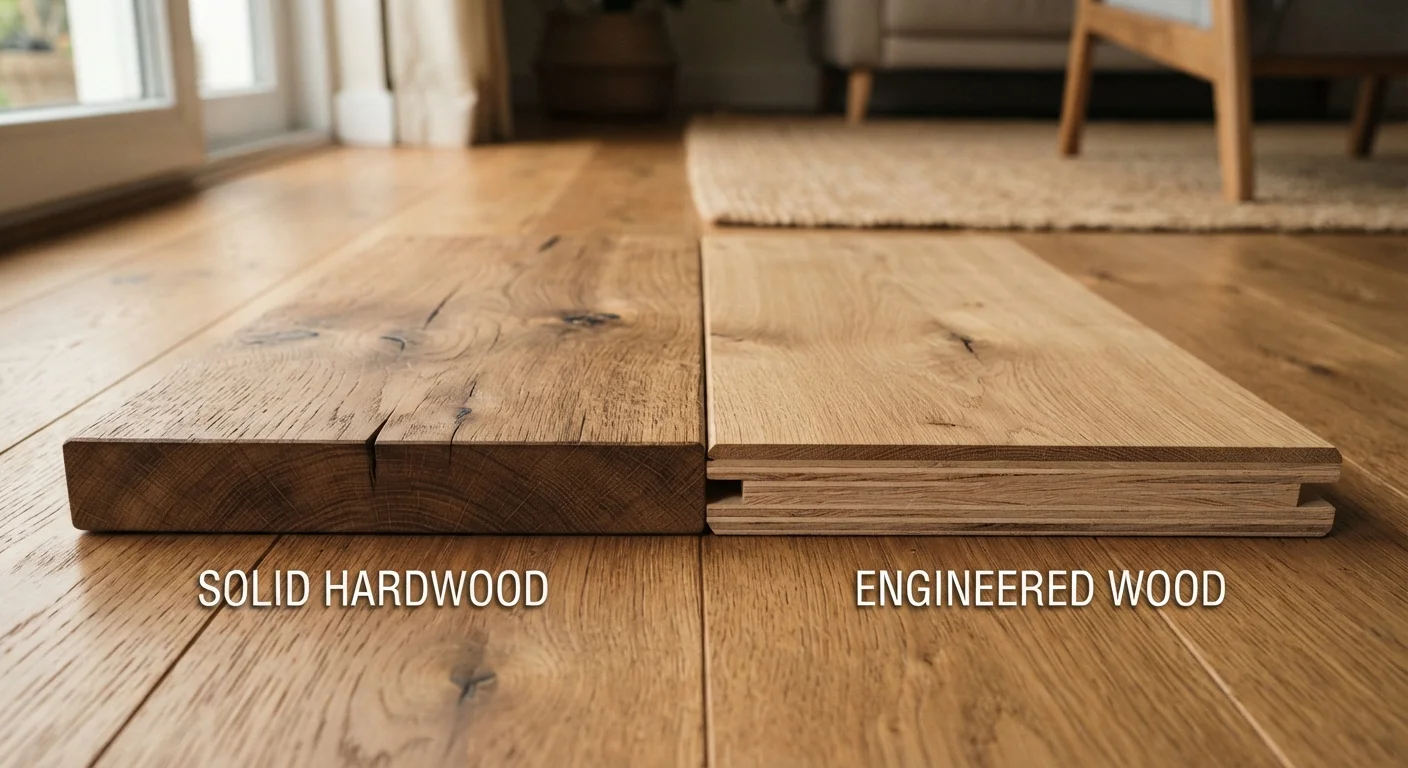
What Each Product Actually Is
Solid hardwood flooring is exactly what it sounds like: a single piece of milled wood, typically ¾-inch thick, cut from species like oak, maple, hickory, or walnut. Its thickness is what gives it the ability to be sanded and refinished repeatedly over the decades.
Engineered wood is a layered product - a real hardwood veneer bonded over a core of plywood or high-density fiberboard (HDF). The veneer layer, which determines the floor's species appearance, typically ranges from 1/16-inch to about 1/8-inch thick on most products. The cross-ply construction is deliberately designed to resist the expansion and contraction that wood naturally undergoes as humidity and temperature change.
Both are real wood products. The distinction matters because engineered wood is sometimes confused with laminate, which uses a photographic layer over a composite core - a different product category entirely.
How They Compare Across the Factors That Matter
The right flooring decision comes down to several concrete factors. Here's how the two products stack up where it counts most.
| Solid Hardwood | Engineered Wood | |
|---|---|---|
| Core composition | Single solid wood plank | Hardwood veneer over plywood/HDF core |
| Typical thickness | ¾ inch | ⅜ to ½ inch (varies by product) |
| Moisture tolerance | Low - expands/contracts significantly | Higher - dimensionally more stable |
| Suitable locations | Above-grade, dry rooms only | Above-, on-, and below-grade (product dependent) |
| Refinishing potential | 5-8 times over lifetime | 1-3 times depending on veneer thickness |
| Installation methods | Nail or staple to subfloor | Glue, nail, staple, or float |
| Radiant heat compatibility | Limited, use with caution | Compatible (product-specific) |
| Lifespan potential | 75-100+ years with care | 25-50 years depending on veneer |
For context on how similar trade-off decisions work across other home improvement categories, see our guide on pressure-treated lumber vs. cedar - the same logic of matching material properties to environment applies.
Moisture, Heat, and Where Each Floor Can Go
Moisture tolerance is the single biggest practical differentiator. Solid hardwood expands and contracts with seasonal humidity changes, which is manageable in a climate-controlled living room but becomes a real problem in basements, bathrooms, or spaces with fluctuating moisture levels. Most flooring manufacturers and installation guidelines advise against solid hardwood below grade (basements) or in full bathrooms.
Engineered wood's cross-ply core gives it significantly more dimensional stability. It's a legitimate option for below-grade installations, kitchens, and over radiant heat systems - provided the specific product is rated for those conditions. Always verify the manufacturer's installation guidelines for radiant heat compatibility, as veneer thickness and adhesive type matter.
Check Humidity Before You Choose
Before selecting either product, measure your home's average relative humidity across seasons - ideally between 35% and 55% for both flooring types. If your space regularly drops below 30% or climbs above 60%, address the humidity issue first. No flooring choice substitutes for a properly conditioned environment, and ignoring it will shorten the life of either product.
Temperature swings also affect solid hardwood more aggressively. Homes with uneven heating, or rooms that get cold in winter and warm in summer, will see more gapping or cupping from solid wood than from engineered alternatives.
Refinishing Lifespan and Long-Term Value
Solid hardwood's ¾-inch thickness means it can typically be sanded and refinished five to eight times over its life - a significant advantage for homeowners who want to update the floor's color or repair surface wear without full replacement. A well-maintained solid hardwood floor can last a century or more.
Engineered wood's refinishing potential is limited by its veneer thickness. Thinner-veneer products (around 1/16 inch) may handle only one light sanding. Premium engineered products with thicker veneers allow two or three refinishes. This is a meaningful constraint if you're planning to own the home for 30-plus years or want maximum flexibility in appearance updates.
Don't Assume Veneer Thickness From the Label
Engineered wood products marketed under the same species name can have veneer layers ranging from paper-thin to a substantial 1/8 inch. If refinishing longevity matters to you, ask the supplier for the exact veneer thickness in writing before purchasing. A floor advertised as 'refinishable' may only tolerate a single very light sanding - which matters if you're planning for the long term.
That said, for many homeowners in typical ownership windows, the refinishing gap matters less than installation flexibility. If the alternative is tile or carpet in a space that isn't suitable for solid hardwood, engineered wood's durability still represents a significant upgrade.
Installation Differences and DIY Considerations
Solid hardwood is typically installed by nailing or stapling to a wood subfloor - a method that requires specific subfloor thickness and flatness tolerances, and is generally outside the scope of beginner DIY projects. It also requires acclimation in the home for several days before installation to reach equilibrium moisture content.
Engineered wood offers more installation flexibility. Depending on the product, it can be glued, nailed, stapled, or floated (clicked together without adhesive). Floating installation in particular makes engineered wood more accessible for confident DIYers, though subfloor flatness still matters significantly. Both products require some acclimation period - check the specific product instructions.
For broader home improvement planning, our breakdown of home insulation types follows the same framework: matching the material to the application rather than defaulting to one option as universally better.
This article provides general educational information about flooring materials. Costs, performance, and installation requirements vary by product and region. Consult a licensed flooring professional for guidance specific to your home's conditions and local building requirements.