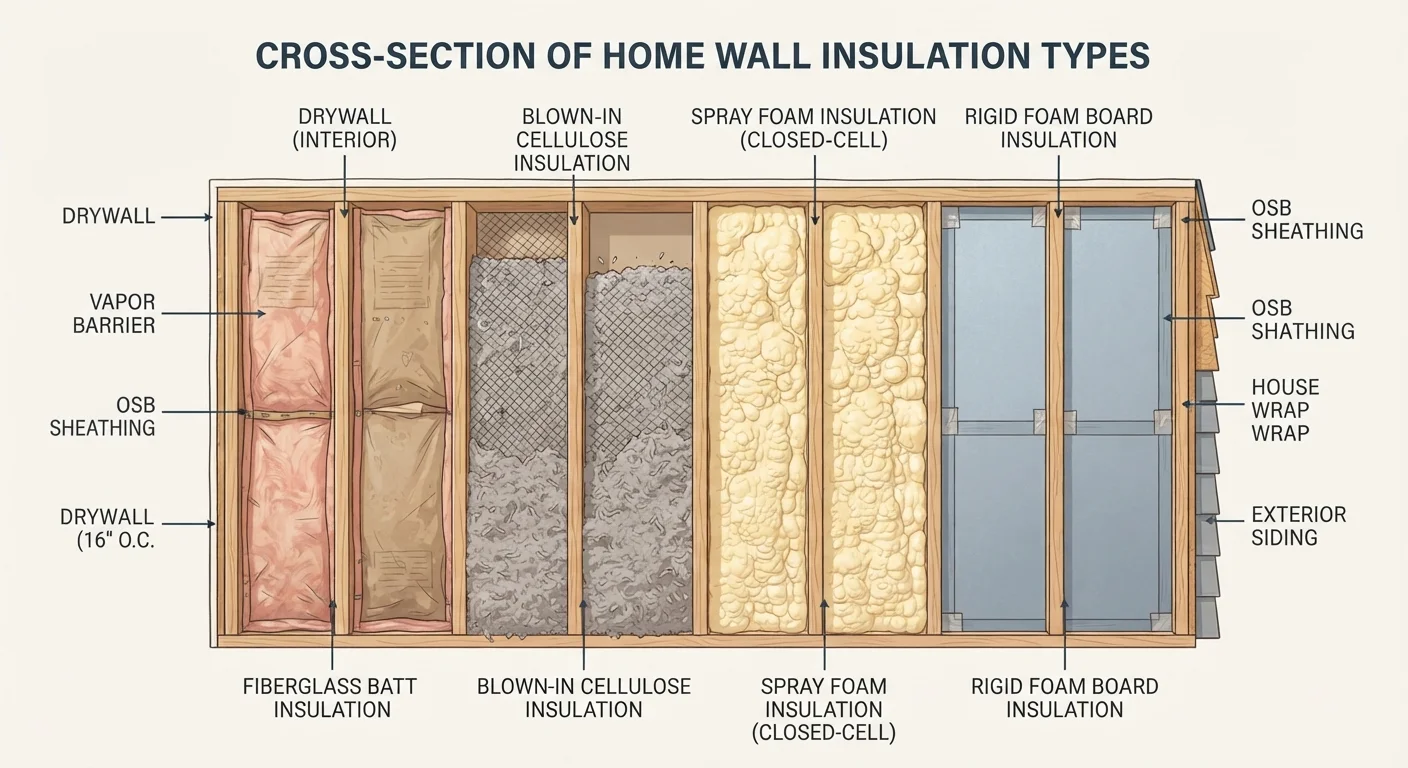
Batt Insulation: The Familiar Standard
Batt insulation - sold in pre-cut panels sized to fit standard 16- or 24-inch stud and joist spacing - is the type most homeowners picture when the subject comes up. Fiberglass is the most common material, though mineral wool (also called rock wool or slag wool) batts are increasingly popular for their higher fire resistance and slightly better soundproofing.
Batts work best in open, accessible cavities: unfinished attic floors, exterior walls during a renovation, and crawl space ceilings. Their weakness is fit. Any gaps, compression, or miscuts around wiring, pipes, or blocking sharply reduce effective R-value. A poorly installed batt can perform well below its labeled rating.
For a straightforward DIY project in an accessible area, batts are a reasonable choice - provided you cut carefully, fill the full cavity depth, and address air sealing separately. Keep in mind that batts alone do not stop air movement; pairing them with caulk or foam sealant at penetrations makes a meaningful difference. See our guide on sealing drafts with caulk and weatherstripping for a practical complement to batt work.
Cut Batts Carefully for Full Performance
A gap as small as 4% of a batt's area can reduce its thermal effectiveness by up to 50%, according to building science research. Use a straightedge and utility knife to make clean cuts, and split batts lengthwise to fit around wiring rather than compressing the material behind it. Compression reduces R-value proportionally.
Blown-In Insulation: Coverage Where Batts Can't Reach
Blown-in insulation - cellulose or loose-fill fiberglass - is pneumatically blown into place using specialized equipment. Cellulose, made primarily from recycled paper, is treated with fire retardants and offers a modest environmental advantage. Loose-fill fiberglass behaves similarly but settles less over time.
Blown-in excels in two situations: topping up an existing attic floor (a fast, cost-effective energy upgrade) and dense-packing finished wall cavities through small holes drilled from the interior or exterior. It conforms around obstructions that would leave gaps in batts. Settling is a real consideration with cellulose - installers account for this by overfilling to a target settled depth.
Renting a blower machine is possible for attic work, but dense-pack wall applications require higher pressure equipment and more technique. Hiring a professional for walls is generally the more reliable path.
Up to 20%
Home heating and cooling energy lost through the attic
The U.S. Department of Energy estimates that inadequate attic insulation is one of the largest single sources of residential energy loss.
R-38 to R-60
Recommended attic insulation level for most U.S. climate zones
The DOE's insulation recommendations vary by climate zone; colder northern climates are at the higher end of this range.
11%
Average heating and cooling savings from air sealing and insulation
The U.S. EPA's ENERGY STAR program estimates this average savings figure for homes that complete comprehensive air sealing and insulation upgrades.
Spray Foam: Air Seal and Insulation Combined
Spray polyurethane foam (SPF) comes in two forms. Open-cell foam is softer and vapor-permeable, with an R-value around R-3.5 to R-3.7 per inch. Closed-cell foam is denser, more moisture-resistant, and reaches R-6 to R-7 per inch - it also adds structural rigidity to wall assemblies. Both expand to fill every gap, making SPF the most effective air-sealing insulation available.
That air-sealing capability is its primary advantage. In homes where drafts account for significant heat loss, spray foam in rim joists, attic hatches, and irregular framing cavities can deliver outsized efficiency gains. Attic-related energy losses are substantial - pairing SPF with proper ventilation strategy is important, as our article on attic ventilation explains.
The trade-offs are real: cost is substantially higher than batts or blown-in, off-gassing during application requires occupants to vacate for 24 hours or more, and improper mixing produces under-performing foam that may need removal. Professional installation is strongly advised for most applications.
Rigid Foam Board: Thin, Versatile, and Moisture-Resistant
Rigid foam board comes in three main formulations: expanded polystyrene (EPS), extruded polystyrene (XPS), and polyisocyanurate (polyiso). R-values range from about R-3.8 per inch for EPS to R-6.5 per inch for polyiso under ideal conditions - though polyiso's performance can dip in very cold temperatures.
Rigid board shines in locations where cavity depth is limited or moisture is a concern. Common applications include basement walls adhered directly to concrete, exterior continuous insulation over wall sheathing, and under-slab insulation. It does not air-seal on its own - seams and edges should be taped or foamed to limit air movement.
One important code consideration: rigid foam on interior surfaces typically requires a thermal barrier (often drywall) to meet fire safety requirements. Verify what your local building code mandates before installation. If you are planning a larger renovation that involves rigid board on exterior walls, that work may pair well with interior finish decisions you are making at the same time.
Foam Board and Fire Code Requirements
Rigid foam insulation is combustible and produces toxic smoke when burned. Most building codes require it to be covered by a thermal barrier - typically at least ½-inch gypsum drywall - on any interior surface. Some products carry listings for use without a thermal barrier in specific applications, but these are exceptions. Always confirm requirements with your local building department before leaving foam board exposed.
Choosing the Right Type for Your Project
No single insulation type is universally best. The practical decision comes down to four factors: location and accessibility, target R-value required by your energy code, moisture exposure, and whether air sealing is handled separately or needs to be built into the insulation itself.
- Open attic floor, new construction walls: Batts or blown-in are cost-effective and code-compliant when installed correctly.
- Finished attic, existing walls: Blown-in dense-pack is usually the most practical retrofit option.
- Rim joists, irregular framing, critical air sealing points: Spray foam provides reliable performance where fit is difficult.
- Basement walls, continuous exterior insulation: Rigid board handles moisture exposure better than fiber-based products.
For most projects, a combination of types - batts in wall cavities plus spray foam at penetrations, for instance - delivers better overall performance than any single material alone. Whatever approach you take, proper installation matters as much as the material you select.
“The best insulation is the one that is installed correctly. A perfect product installed sloppily will consistently underperform a modest product installed with care.”
— Building Science Corporation, Research and consulting organization focused on building enclosure performance