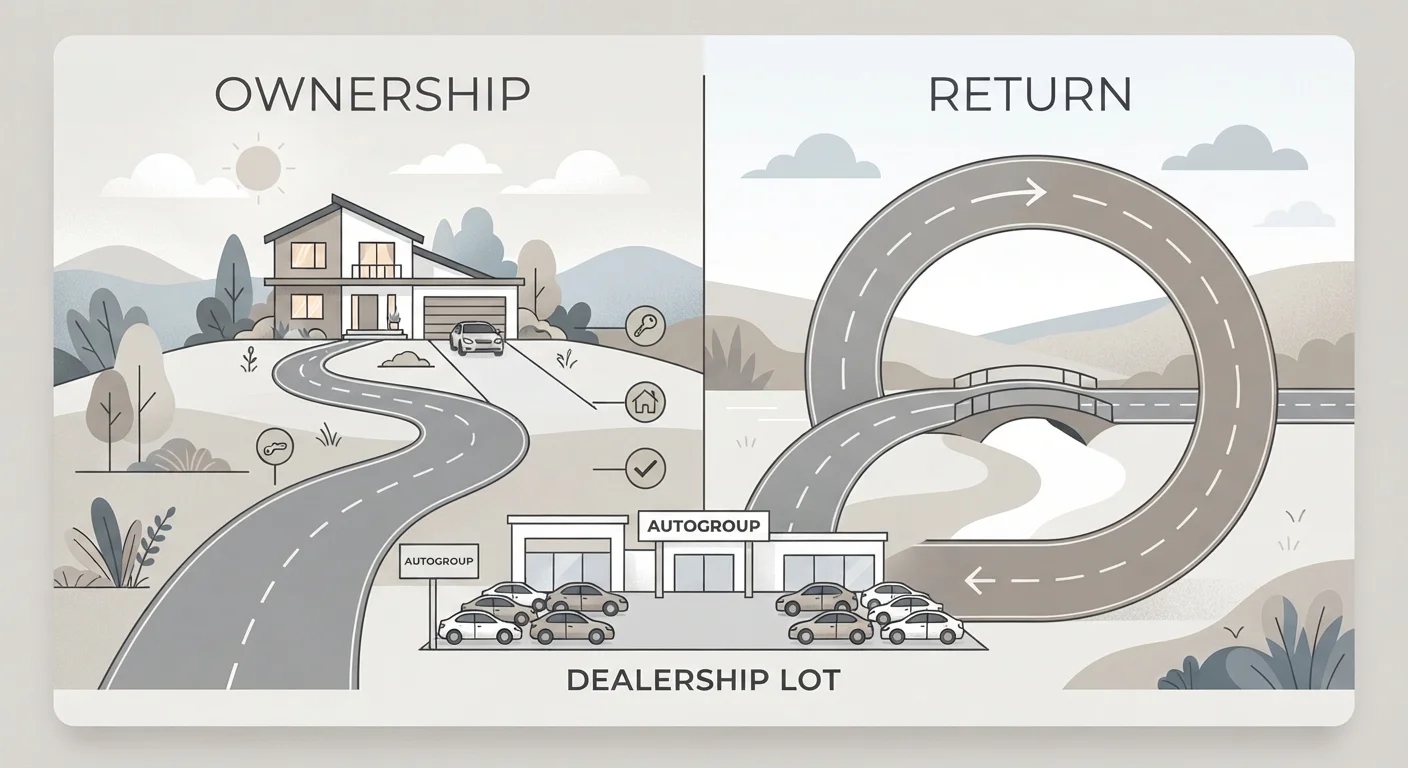
The Core Structural Difference
At their foundation, leasing and financing are two entirely different legal and financial arrangements - not just variations on the same theme.
When you finance a vehicle, you take out a loan to purchase it. The lender holds a lien on the title until the loan is repaid, at which point you own the car outright. Every payment reduces your principal balance and builds equity. The vehicle shows up on your personal balance sheet as an asset.
When you lease a vehicle, you're entering a long-term rental agreement. The leasing company (usually a bank or captive finance arm of the manufacturer) retains ownership of the car throughout the term. You pay for the portion of the vehicle's value you consume - essentially, its expected depreciation over the lease period - plus a financing charge called the money factor. At the end of the term, the car goes back.
This distinction matters because it shapes nearly every practical aspect of how each path works: what you can do with the vehicle, what you owe at any point, and what you walk away with when the agreement ends.
For a broader view of what vehicle ownership involves beyond the financing decision, see our guide to vehicle ownership in America.
How Payments Are Calculated
Understanding how each payment is derived clarifies why leases typically show lower monthly figures - and what that lower number actually reflects.
Loan payments are calculated based on the vehicle's full purchase price (minus any down payment), the loan's annual percentage rate (APR), and the repayment term. You're retiring the entire cost of the vehicle over a set number of months.
Lease payments are calculated differently. The dealer and lender agree on a residual value - what the vehicle is projected to be worth at lease end. You pay only the difference between the selling price and that residual, spread over the term, plus the money factor (equivalent to an interest rate). Because you're financing a smaller dollar amount, monthly payments are typically lower.
| Criterion | Leasing | Financing |
|---|---|---|
| Ownership at end of term | Vehicle returned to lessor | Vehicle owned outright |
| Monthly payment basis | Depreciation + money factor | Full purchase price + APR |
| Typical monthly payment | Generally lower | Generally higher |
| Mileage restrictions | Yes - overage fees apply | None |
| Ability to modify vehicle | Severely limited | Unrestricted |
| Early exit costs | High termination penalties | Usually straightforward |
| Long-term cost (10+ years) | Higher if leasing continuously | Lower once loan is paid off |
| Equity built | None | Yes - grows with each payment |
It's worth noting that a lower monthly payment doesn't mean leasing is cheaper overall. If you lease the same vehicle back-to-back over ten years, total outlay will generally exceed what you'd pay to purchase and keep that vehicle. New vs. used purchase decisions also factor into this math, since financing rates and depreciation curves differ meaningfully between the two.
Restrictions, Obligations, and End-of-Term Options
The day-to-day experience of leasing and financing diverges most sharply around restrictions and what happens when the agreement ends.
Leases come with contractual constraints that loans do not. The most significant:
- Mileage limits: Most leases cap annual mileage at 10,000-15,000 miles. Exceeding the cap triggers per-mile overage fees, typically ranging from $0.10 to $0.25 per mile, depending on the agreement.
- Wear-and-tear standards: Lessees are responsible for returning the vehicle in acceptable condition. Damage beyond normal use can result in end-of-lease charges.
- Early termination penalties: Ending a lease before the term expires is expensive and often complicated. Loan prepayment, by contrast, is usually straightforward.
At lease end, you typically have three options: return the vehicle, purchase it at the predetermined residual price, or (if available) roll into a new lease. At loan payoff, you simply own the vehicle - no further decision required.
The Lease Buyout Option Explained
Most lease agreements include a buyout clause that lets you purchase the vehicle at its residual value when the lease expires. If the car has held its value better than the residual predicted - or if you've grown attached to it - buying out the lease can sometimes make financial sense. However, buyout prices are set at contract signing and may not reflect actual market conditions at lease end. Compare the residual price against current market values before deciding.
If you eventually plan to sell your financed vehicle, understanding private sale versus trade-in options can help you recoup the most value from your ownership equity.
Credit, Insurance, and Long-Term Cost Considerations
Both leasing and financing require a credit check, and approval terms - including the interest rate on a loan or the money factor on a lease - will reflect your credit profile. Stronger credit generally yields better terms on either path. For context on how credit works in these transactions, the Credit & Banking hub offers relevant background.
One frequently overlooked difference is insurance. Lease agreements typically require higher liability limits and lower deductibles than lenders do, since the leasing company has a continuing ownership interest in the vehicle. This can translate to higher insurance premiums for lessees compared to buyers carrying only lender-required coverage.
~30%
Share of new vehicle transactions that are leases
According to Experian's State of the Automotive Finance Market reports, leasing has historically accounted for roughly 25-30% of new vehicle transactions in the U.S., though the share fluctuates with interest rates and inventory conditions.
11-12 years
Average age of vehicles on U.S. roads
S&P Global Mobility data indicates the average U.S. passenger vehicle in operation is approximately 12 years old, suggesting many Americans keep financed vehicles long after loan payoff.
Over a full ownership lifetime, financing tends to produce a lower cumulative cost - particularly if you keep the vehicle for several years after the loan is paid off, when you have zero monthly payment. Leasing, by design, means a monthly payment in perpetuity as long as you continue leasing. That said, leasing may suit drivers for whom access to newer vehicles, warranty coverage, and predictable expenses matter more than long-term cost minimization. Neither path is universally superior; the right choice depends on your driving habits, financial priorities, and how you actually use a vehicle day to day.
This article provides general educational information about vehicle financing and leasing and does not constitute personalized financial or legal advice. Consult a qualified financial professional for guidance tailored to your situation.