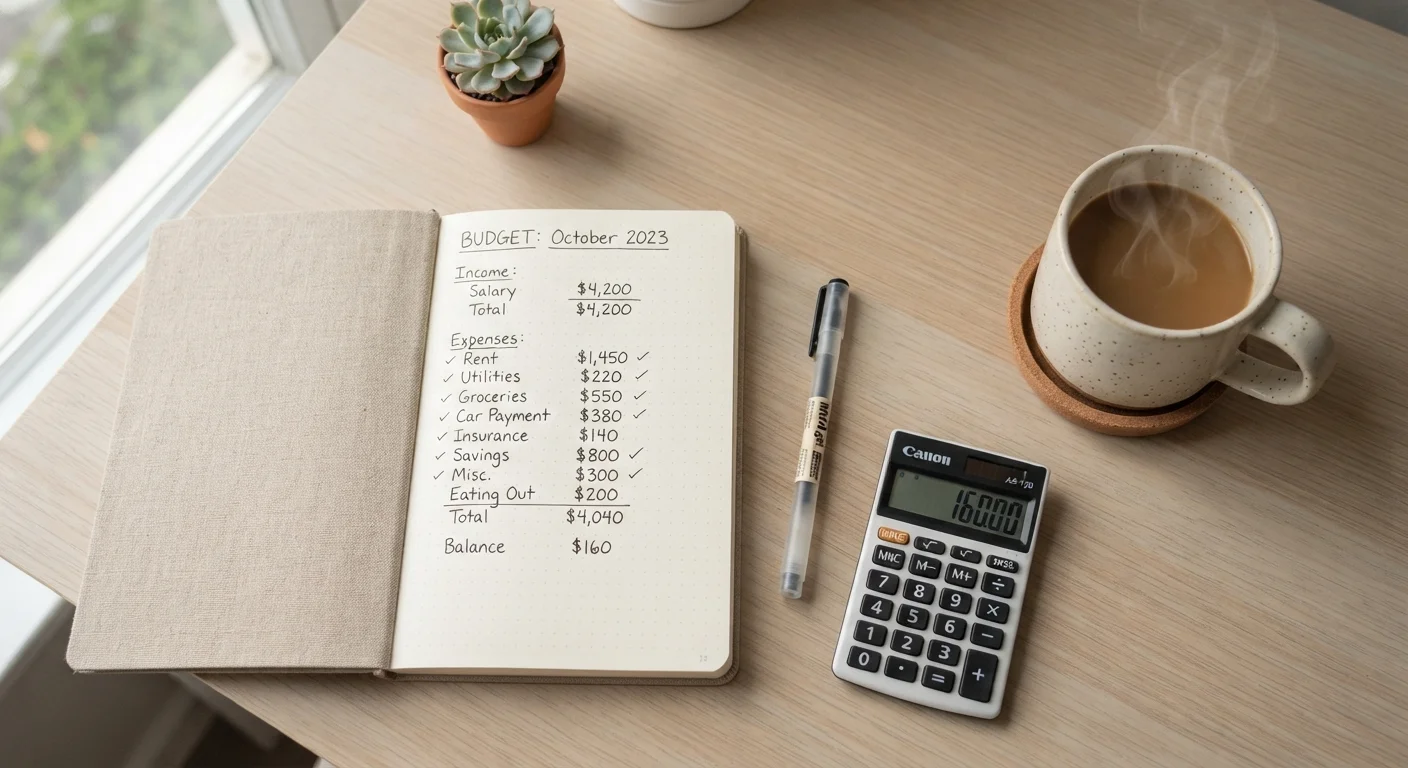
What a Budget Actually Is (And Isn't)
A budget is simply a written plan that tells your money where to go before you spend it. That's it. It is not a strict punishment, a sign that you're struggling, or something only people with complicated finances need. Think of it the way you'd think of a grocery list: it doesn't stop you from buying what you want, it just keeps you from leaving the store having forgotten half of what you needed.
What a budget is not: a guarantee of financial success, a one-size-fits-all formula, or something you set up once and never touch again. A good budget is a living document that you update as your life changes.
Take-home pay
The amount of money you actually receive after taxes and other deductions are removed from your paycheck. This is what you have available to spend and save.
Fixed expense
A cost that stays the same amount each month, such as rent or a loan payment. These are easy to plan for because the number doesn't change.
Variable expense
A cost that changes from month to month, like groceries or gas. These require closer tracking because the amount fluctuates.
Zero-based budget
A budgeting method where you assign every dollar of income to a specific category - including savings - so that income minus all allocations equals zero.
Emergency fund
A dedicated pool of savings set aside to cover unexpected costs, such as a car repair or medical bill, without going into debt.
If you've heard of the 50/30/20 budgeting framework, that's one popular structure - but before you apply any framework, you need the raw numbers. That starts with your income.
Step 1: Add Up Your Income
Your budget starts with take-home pay - the amount that actually lands in your bank account after taxes, not your gross salary. If your employer deducts taxes, health insurance, or retirement contributions before the paycheck arrives, those deductions are already factored in; use what you receive.
- Salaried workers: Divide your annual take-home pay by 12 for a monthly figure, or multiply one paycheck by the number you receive each month.
- Hourly workers: Multiply your average weekly hours by your hourly rate, then multiply by 4.3 (the average number of weeks in a month).
- Variable income: Use your lowest recent monthly amount as a conservative baseline.
Include all income sources - a side gig, freelance work, child support, or rental income - but be conservative. Only count money you can reliably count on.
Use Net, Not Gross
Always base your budget on your take-home (net) income, not your gross salary. Budgeting from a larger gross number almost always leads to overspending, because that money was never actually yours to spend. If you're unsure of your monthly net, check a recent pay stub or log in to your payroll portal.
Step 2: List Your Expenses
Pull up two to three months of bank and credit card statements and write down every category you spent money in. Sort them into two groups:
- Fixed expenses
- These stay the same amount each month - rent, car payment, insurance premiums, loan minimums.
- Variable expenses
- These change month to month - groceries, gas, dining out, clothing, entertainment, personal care.
Don't forget irregular expenses that don't show up every month: car registration, annual subscriptions, holiday gifts, or medical copays. Estimate an annual total for these and divide by 12 to give them a monthly line in your budget.
Be honest here. Many first-time budgeters underestimate variable spending by 20-30% simply by relying on memory rather than actual statements. Your bank history is more accurate than your gut.
Don't Budget from Memory Alone
Recalling spending from memory consistently underestimates how much you actually spend, especially on small, frequent purchases. Always cross-reference your recollections against real bank and credit card statements from the past two to three months. Accuracy here is what makes the rest of your budget reliable.
Step 3: Assign Every Dollar a Job
Now subtract your total planned expenses from your take-home income. The result should be zero - or very close to it. This is called a zero-based budget: every dollar of income gets assigned to a category, including savings and debt repayment, until nothing is left unassigned.
If you have money left over after covering necessities, assign it intentionally. Options include:
- Adding it to a starter emergency fund (a common first savings goal is $500 to $1,000)
- Applying extra payments to high-interest debt
- Funding a specific savings goal like a vacation or car repair fund
If your expenses exceed your income, look first at variable categories - subscriptions, dining, discretionary spending - for reductions. Our hub on Saving & Debt has guidance on tackling debt while building savings simultaneously.
One method that works well for beginners is the cash envelope system. See Tracking Every Dollar: Envelope Budgeting in a Digital Age for how it works and its digital equivalents.
Step 4: Track and Adjust
Building the budget is step one. Following through requires tracking your actual spending against your plan throughout the month. Check in weekly - it only takes five to ten minutes - to see whether you're on pace in each category.
When a category runs over (and it will, especially early on), don't abandon the budget. Instead, move money from a category that's underspent. This is normal financial management, not failure.
At month's end, compare planned versus actual spending. Use that data to make the next month's budget more accurate. Most people find their budget gets significantly more realistic by month three. For a structured way to do this, a monthly budget health check can keep you on track each month.
A bank account that separates spending money from savings can make tracking easier. If you haven't set one up yet, opening your first bank account walks you through what you'll need.
Common Beginner Mistakes to Avoid
Even well-intentioned first budgets run into predictable problems. Knowing them in advance gives you a head start:
- Setting categories too tight. Budgeting zero dollars for fun or restaurants rarely lasts. Build in a realistic (not aspirational) amount for enjoyment, or you'll resent the budget and quit.
- Forgetting irregular expenses. Annual fees, seasonal costs, and one-off expenses derail budgets that only account for monthly recurring bills. Always factor in the irregular.
- Treating the first draft as final. Your first budget is a hypothesis. Expect to revise it.
- Ignoring small purchases. A $6 coffee every workday adds up to roughly $130 a month. Small spending categories deserve real line items.
If you find your budget falling apart after the first few weeks, you're not alone - and it's fixable. Understanding why budgets fail in month two can help you identify the root cause and course-correct without starting over.
For a longer-term view, Building a Budget That Actually Lasts covers how to adapt your plan as your life evolves - without throwing out everything you've built.
This article is for general informational and educational purposes only and does not constitute personalized financial advice. For guidance specific to your situation, consider consulting a licensed financial professional or a nonprofit credit counselor.