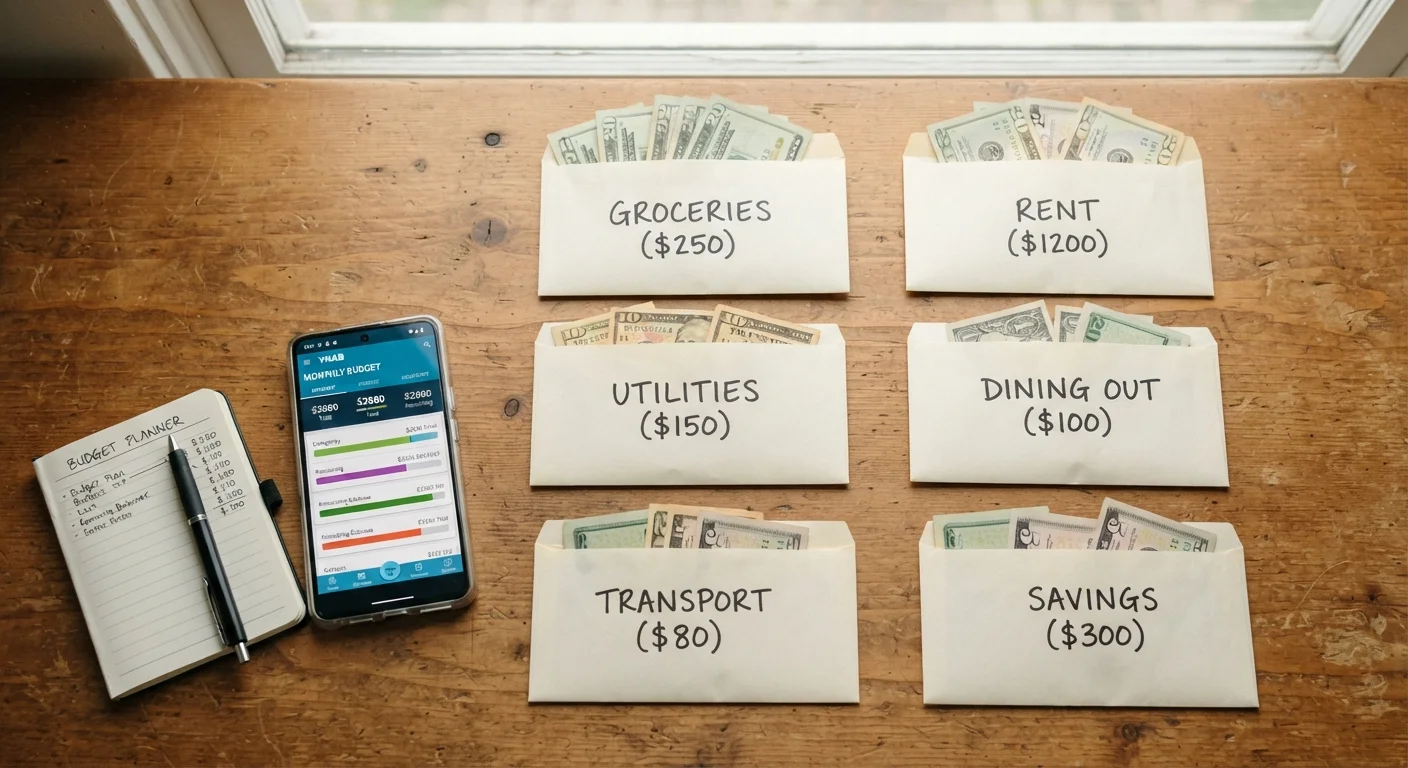
How the Envelope Method Works
The mechanics are straightforward. At the start of each budget period - usually monthly - you list your expected income and break it into spending categories: groceries, gas, dining out, clothing, household supplies, and so on. You assign a specific dollar amount to each category. In the traditional version, you withdraw that cash and place it physically into labeled envelopes.
Throughout the month, you spend only from the relevant envelope for each purchase. When an envelope runs dry, that category is closed for the period. There is no borrowing from next month; that boundary is the system's key feature.
This approach is a form of zero-based budgeting - every dollar of income is assigned a job before it's spent. The result is a budget that reflects your actual priorities rather than your general intentions. For a structured introduction to building those categories from scratch, the beginner's budgeting walkthrough is a useful starting point.
Start with Just Three or Four Envelopes
Beginners often try to track too many categories at once, which quickly becomes overwhelming. Start with the two or three areas where you most frequently overspend - groceries, dining out, and entertainment are common candidates. Once those feel manageable, you can expand your system. Complexity added gradually tends to stick; complexity added all at once rarely does.
The Psychology Behind the Cash Envelope
Research in behavioral economics consistently finds that paying with cash feels more painful than swiping a card. This "pain of paying" isn't a bug - it's a feature. When you hand over a $20 bill at a restaurant and watch your dining envelope thin out, the spending becomes visceral in a way that a digital transaction rarely is.
That friction slows impulsive decisions. It also makes the budget visible. Rather than checking a statement at the end of the month to discover you overspent on takeout, you see the remaining cash in real time. The envelope becomes a live dashboard with no app required.
“The act of paying in cash makes the cost of a purchase feel more real. When money is abstract, it's easy to spend more than you intend.”
— Dan Ariely, Behavioral economist and author on predictably irrational financial decision-making
This is particularly powerful for categories that routinely derail budgets - the everyday purchases that feel small individually but accumulate quickly across a month.
Digital Envelopes: The Same System, Without the Cash
Carrying large amounts of cash is impractical for many people, and most transactions today are digital. A range of budgeting apps replicate the envelope structure virtually, letting users assign dollar limits to categories and track spending against them in real time. When a virtual envelope hits zero, the app flags it - performing the same stop-spending signal the empty physical envelope once provided.
Spreadsheets can serve the same function with a bit more setup. A simple table with category names, allocated amounts, running totals, and remaining balances recreates the envelope logic without any subscription fee. For a side-by-side look at how apps and spreadsheets compare in practice, see Spreadsheet vs. Budgeting App.
36%
Americans who track spending monthly
A Federal Reserve survey on household economics found a significant share of adults do not actively monitor their monthly spending against a plan.
~$300
Average monthly food-at-home spending per person
According to the U.S. Bureau of Labor Statistics Consumer Expenditure Survey, food-at-home is one of the most common categories where envelope-style limits are applied.
Whether you choose physical cash or a digital equivalent, the underlying discipline is identical: categories are fixed in advance, and spending stops at the limit.
Who Benefits Most - and Where the System Has Limits
Envelope budgeting tends to work best for people who consistently overspend in a handful of variable categories and want a hard, visible limit rather than a soft guideline. It's also effective for anyone building the foundational habit of tracking spending before moving to more sophisticated systems.
The method has real limitations. It doesn't handle irregular or annual expenses - car insurance, medical bills, or holiday spending - without supplementary planning. It also requires more active management than automated savings transfers or fixed bill pay. And for households with complex finances or variable incomes, rigid category limits may need frequent adjustment.
Using the Monthly Budget Health Check alongside envelope budgeting helps catch category drift early and keeps limits realistic as your expenses shift. Those who stick with it often describe the system less as a restriction and more as a financial clarity tool - knowing exactly how much is left, in every category, at every point in the month.
This article is for general informational and educational purposes only and does not constitute personalized financial advice. Consult a qualified financial professional for guidance tailored to your individual circumstances.