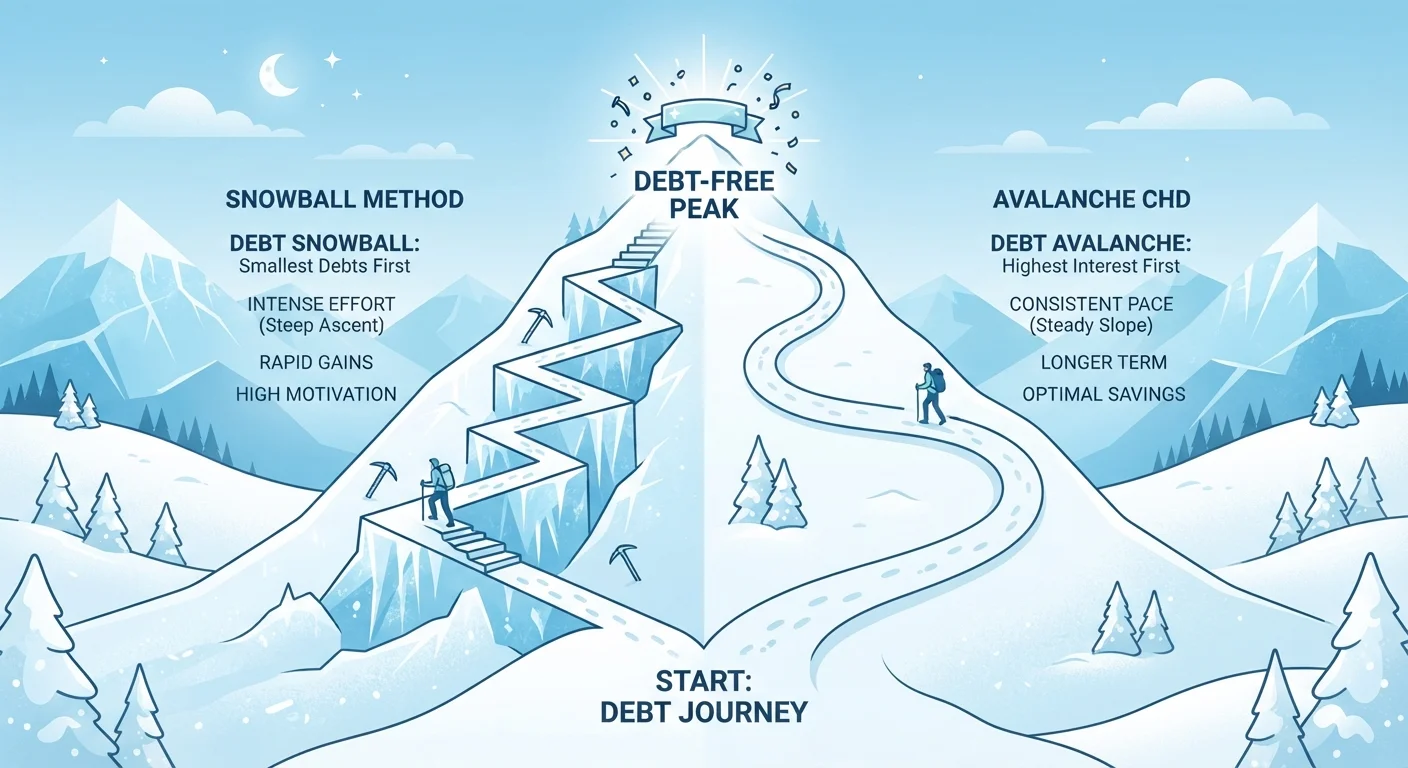
How Each Strategy Works
Both the avalanche and snowball methods share the same basic structure: pay the minimum due on every debt each month, then direct any additional available money toward one target debt. The strategies differ only in which debt gets that extra payment.
Avalanche method: You rank your debts from highest interest rate to lowest. Extra money goes to the highest-rate balance first. Once that balance reaches zero, you roll its payment into the next highest-rate debt, and so on. Because high-interest debt is the most expensive to carry, eliminating it quickly limits how much interest accumulates across your total debt load. To understand why this matters so much, see how compound interest works against you in debt.
Snowball method: You rank your debts from smallest balance to largest, regardless of interest rate. Extra money targets the smallest balance. When that account hits zero, its freed-up payment attacks the next smallest, creating a growing "snowball" of cash directed at each successive debt. The appeal is speed of closure - you eliminate accounts faster, which many people find genuinely reinforcing.
| Criterion | Avalanche Method | Snowball Method |
|---|---|---|
| Ordering principle | Highest interest rate first | Smallest balance first |
| Total interest paid | Lower (mathematically optimal) | Typically higher |
| Time to first paid-off account | Potentially longer | Faster early wins |
| Psychological motivation | Driven by long-term savings logic | Driven by visible account closures |
| Complexity | Requires tracking interest rates | Simple balance ranking |
| Best outcome depends on | Discipline and rate spread | Consistency and motivation style |
The Real Cost Difference
In a direct mathematical comparison, the avalanche method almost always produces a lower total interest cost. The gap depends on how different your interest rates are and how long repayment takes. With similar rates across all your debts, the difference may be modest. With a wide spread - say, a 24% APR credit card alongside a 6% personal loan - the savings from targeting the high-rate balance first can be meaningful. What high-interest debt actually costs you over time illustrates how carrying a high-rate balance compounds quietly but significantly.
~$1,000+
Potential interest savings with avalanche on mixed debt
Financial planning illustrations commonly show four-figure interest savings when high-rate balances of several thousand dollars are eliminated before lower-rate ones.
33%
Share of U.S. adults carrying credit card debt month-to-month
According to Federal Reserve survey data, roughly one in three American adults carries a credit card balance from month to month, making repayment strategy a widely relevant decision.
The snowball method's trade-off is paying more in total interest in exchange for psychological payoffs. Research in behavioral economics has found that people are more likely to continue a debt repayment plan when they experience early successes - meaning the snowball's "inefficiency" may actually produce better outcomes for borrowers who would otherwise abandon a plan midway through.
If you are weighing whether to consolidate before choosing a strategy, debt consolidation has real trade-offs worth reviewing before committing to either approach.
Choosing the Approach That Works for You
The most effective debt payoff method is the one you will actually follow consistently for as long as it takes. A mathematically optimal strategy abandoned after three months accomplishes less than a slightly less efficient strategy maintained for three years.
Ask yourself a few practical questions:
- Do I find tracking interest rates and calculating savings motivating, or does that abstraction feel remote?
- Have I struggled to stick with financial plans in the past - and if so, what derailed them?
- How far apart are my interest rates? A narrow spread makes the avalanche's advantage smaller.
- Do I have many small accounts, or a few large ones? Snowball shines when closing individual accounts quickly is genuinely satisfying.
Some borrowers also use a hybrid: apply snowball logic first to eliminate one or two very small nuisance balances, then switch to avalanche for the remaining high-rate debts. This is not a textbook approach, but financial strategy should serve your life - not the other way around.
Both Methods Require Minimum Payments First
Whichever strategy you choose, always make the minimum required payment on every account before directing extra funds to your target debt. Missing a minimum payment triggers late fees, potential penalty interest rates, and credit score damage - all of which undermine your repayment progress. Set up autopay for minimums if possible to remove that risk entirely.
Before aggressively directing every spare dollar to debt, it is also worth considering whether maintaining some savings in parallel makes sense. Saving while in debt can sometimes be the smarter move, particularly if you have no emergency fund to absorb unexpected expenses. Similarly, draining savings entirely to pay off debt carries its own risks worth understanding first.
This article is for general informational and educational purposes only and does not constitute personalised financial or legal advice. Consult a licensed financial professional for guidance specific to your situation.