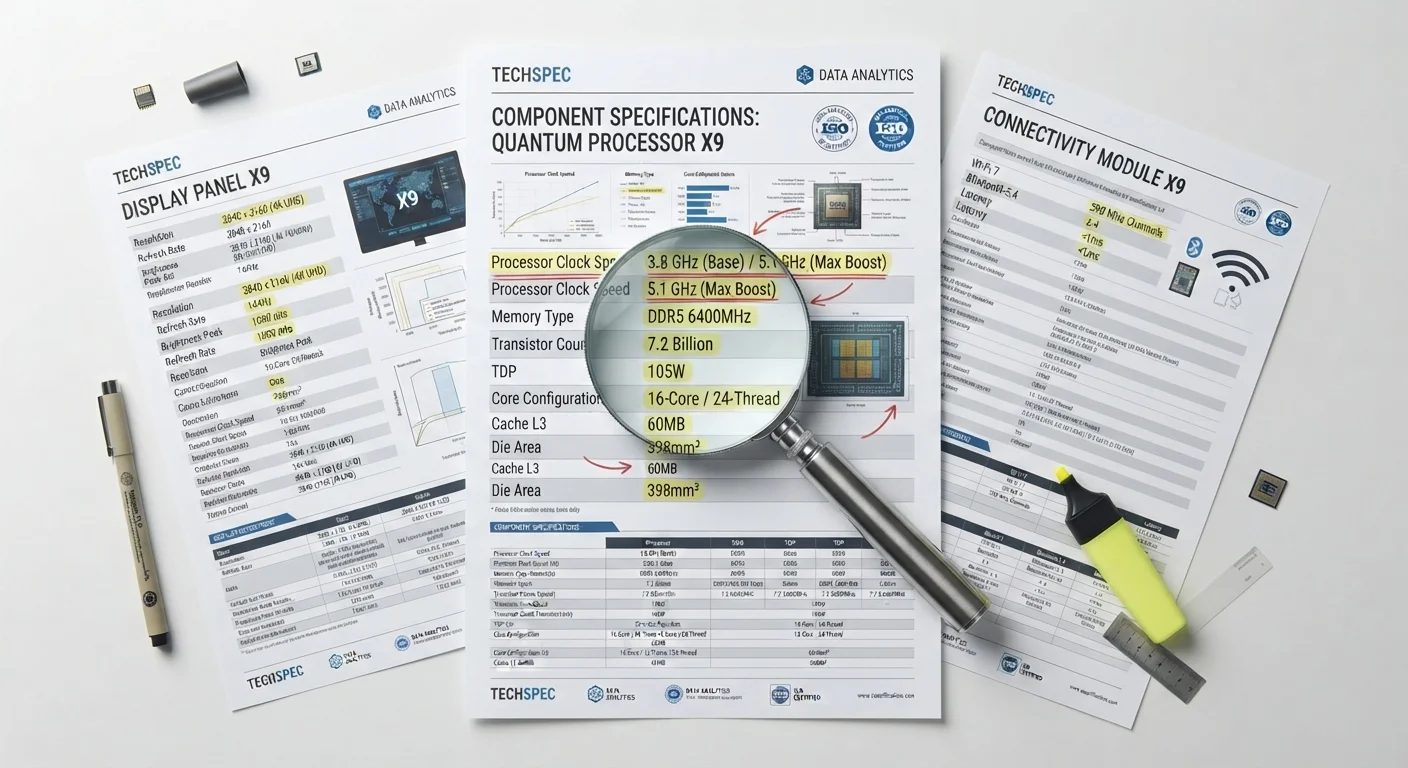
Why Bigger Numbers Win on Paper but Not Always in Practice
Spec sheets are designed to communicate technical capability quickly. The problem is that raw numbers strip away context - and context is exactly what determines whether a device will work well for you. Manufacturers know that shoppers scan for the largest values: most megapixels, highest clock speed, biggest battery. Listings are structured around that behavior.
This isn't inherently dishonest, but it creates a systematic gap between what looks good in a comparison table and what performs well in daily use. Marketing claims on electronics packaging often tell only half the story - and spec numbers are a major part of that selective presentation.
Specs Are Marketing Tools Too
Manufacturers choose which numbers to highlight based on what looks impressive, not necessarily what's most relevant to your use. A single spec pulled out of context - like a processor's maximum boost clock - may never reflect the device's typical sustained performance. Always look for independent testing that reflects real-world conditions before drawing conclusions from a box or product page.
The mistakes below represent the most common ways this number-first thinking leads buyers in the wrong direction. Each one has a clear remedy once you understand what the spec is actually measuring.
The Most Common Spec Mistakes and How to Sidestep Them
Treating megapixel count as the primary indicator of camera quality.
Why it happens: Megapixels are an easy, single number to compare, and manufacturers advertise them prominently because they're tangible and scalable.
Assuming a higher GHz clock speed means a faster processor in practice.
Why it happens: Clock speed sounds intuitive - faster cycles should mean faster computing. But this logic only holds when comparing chips within the same architecture generation.
Interpreting a larger mAh battery rating as a guarantee of longer battery life.
Why it happens: Capacity in milliamp-hours feels like a direct measure of endurance, and it is - but only when all other variables are equal, which they rarely are.
Equating higher RAM with meaningfully better everyday performance beyond a reasonable threshold.
Why it happens: RAM is visible, comparable, and widely discussed - making it feel like more is always better, regardless of how the device will actually be used.
Ignoring software and architectural improvements when evaluating specs across device generations.
Why it happens: Shoppers often compare spec sheets between model years without accounting for how much engineering efficiency has changed underneath those numbers.
Beyond these individual metrics, there's a broader habit worth developing: reading a full spec sheet in context rather than cherry-picking headline figures. Reading a spec sheet without getting overwhelmed is a learnable skill that pays off across every device category.
Don't Compare Specs Across Categories
A 108MP camera sensor in a budget smartphone and a 12MP sensor in a professional mirrorless camera are not meaningfully comparable by megapixel count alone. Sensor size, pixel pitch, lens quality, and processing pipeline all shape the final image. Comparing raw numbers across different product tiers or device categories almost always produces misleading conclusions.
Building a More Reliable Evaluation Framework
The antidote to spec inflation is a use-case-first approach: define what you actually need a device to do before you open a comparison page. Display-heavy users should understand what screen resolution, refresh rate, and panel type actually affect rather than defaulting to the highest resolution available. Wireless-reliant users should think through the real trade-offs between wired and wireless across device categories before assuming wireless always means better.
12MP
Sensor resolution used in many professional cameras
Professional-grade cameras with 12-24MP sensors routinely outperform budget smartphones with 108MP sensors due to larger sensor size and superior optics.
~20%
Typical real-world battery life gap vs. rated spec
Independent device testing consistently shows real-world battery life falling 15-25% below manufacturer ratings, which are measured under controlled lab conditions.
One spec almost never found on a box also deserves attention: software support duration. Software support cycles determine a device's long-term value more reliably than any hardware number - a device with fewer megapixels but five years of security updates is often the smarter long-term choice.
If you're still building foundational knowledge, electronics literacy for first-time buyers and a structured checklist of questions to ask before buying are practical starting points that will serve you across any purchase decision.