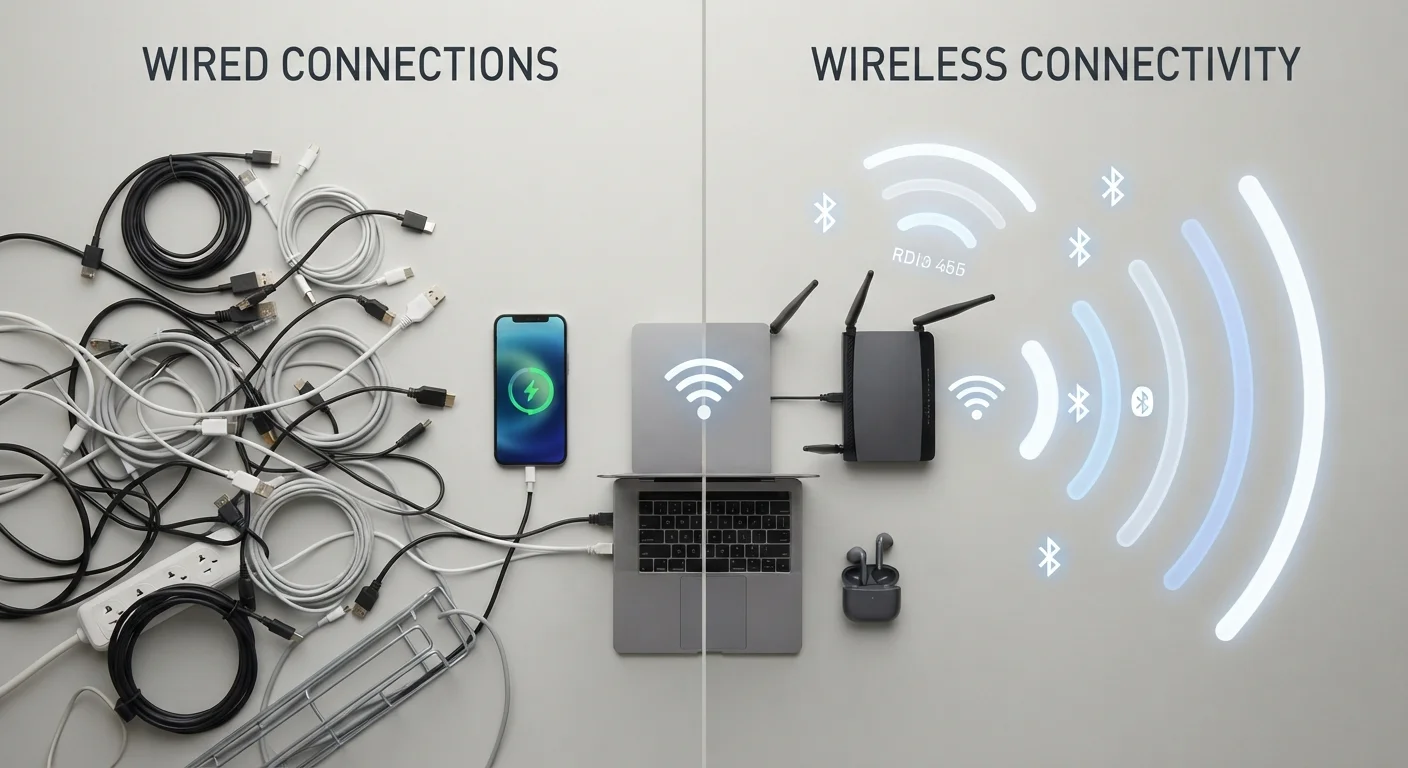
Why the Wired vs. Wireless Question Isn't Simple
Marketers frame the wired-versus-wireless debate as a lifestyle choice - cables are clunky, wireless is freedom. The reality is more technical and more nuanced. The trade-offs are real, and they play out very differently depending on the device category. A wireless mouse operates under different constraints than wireless earbuds or a wireless charger, so a blanket answer serves nobody well.
The core variables are latency (signal delay), bandwidth (data throughput), reliability (resistance to interference), and power (ongoing battery cost). Understanding how each variable weighs in a given context is the foundation of a genuinely informed decision. For a deeper look at the underlying connection standards involved, our guide to connectivity ports and protocols explains what each standard actually enables.
| Criterion | Wired | Wireless | |
|---|---|---|---|
| Latency | Minimal, consistent | Higher, varies by protocol | |
| Reliability | No interference risk | Subject to RF congestion | |
| Charging overhead | None | Ongoing battery management required | |
| Mobility | Tethered to device | Free range within signal reach | |
| Audio quality ceiling | No codec compression | Codec-dependent, improving | |
| Setup complexity | Plug and play | Pairing and driver management | |
| Charging efficiency | Higher, faster | Lower, more heat generated |
Headphones and Earbuds: Where Wireless Has Come Furthest
Wireless audio technology - specifically Bluetooth - has improved dramatically. Modern codecs like aptX Adaptive and LC3 (used in Bluetooth LE Audio) deliver audio quality that is indistinguishable from wired for most casual listeners. Latency, historically the biggest objection, has dropped to around 20-40 milliseconds on current hardware, which is imperceptible during music playback and acceptable for most video watching.
However, two caveats matter. First, for professional monitoring - recording, mixing, or any task requiring sample-accurate sync - wired remains the reliable standard. Second, wireless earbuds add battery management as a permanent responsibility. Advertised battery life is almost always measured under lab conditions; real-world use with active noise cancellation running typically cuts that figure noticeably. See how battery life ratings are measured and what they mean in practice before taking spec-sheet numbers at face value.
Check the Codec, Not Just the Connection
Not all Bluetooth audio is equal - the codec negotiated between your source device and your earbuds determines actual audio quality and latency. If your phone and headphones support different codecs, they'll fall back to a lower common standard. Check what both devices support before assuming you're getting the full benefit of either.
Gaming Mice and Keyboards: Where Latency Still Matters
The gap between wired and wireless has narrowed for gaming peripherals, but it hasn't closed. High-performance wireless mice using 2.4 GHz proprietary RF (not Bluetooth) can achieve polling rates that rival wired connections for most players. Bluetooth is generally not recommended for gaming due to its higher and less consistent latency.
The more honest issue is interference. A crowded 2.4 GHz environment - common in apartments or offices with many Wi-Fi devices - can introduce signal instability. Wired input is immune to this by definition. For casual gaming and productivity, wireless is a perfectly workable choice. For competitive play where consistency is non-negotiable, the wired option removes one variable entirely.
2.4 GHz Congestion Is a Real Issue
Wireless peripherals using 2.4 GHz RF share spectrum with Wi-Fi routers, microwaves, baby monitors, and other devices. In dense living situations, this can cause dropped inputs or lag spikes that are difficult to diagnose. If you're in a heavily connected household and notice erratic wireless peripheral behavior, interference is a logical first suspect - not necessarily a defective product.
Charging: Wireless Convenience Comes with Real Costs
Wireless charging (Qi and Qi2 are the dominant standards in the U.S.) is genuinely convenient, but it transfers energy less efficiently than wired charging. Studies from device testing labs consistently show wireless charging generates more heat and takes longer than a comparable wired connection - factors that can affect long-term battery health over many charge cycles.
Wired charging, particularly over USB-C with Power Delivery (PD) protocols, is faster, more efficient, and works regardless of case thickness or precise pad alignment. The choice here is straightforwardly about convenience versus efficiency - both are valid priorities, but consumers should make that trade-off consciously rather than assume wireless charging is equivalent. Spec numbers for charging rarely tell the full story - wattage figures in particular are peak values, not sustained rates.
Before committing to any specific device setup, a structured checklist of compatibility and longevity questions can help surface factors that marketing materials quietly skip over.
~47%
Typical wireless charging efficiency loss vs. wired
Independent device testing has found wireless charging can use roughly 40-50% more power than wired to deliver the same charge, depending on pad and device alignment.
20-40ms
Bluetooth audio latency on modern codecs
Current aptX Adaptive and LC3 implementations achieve latency figures in this range, compared to 100-200ms on older Bluetooth standards.