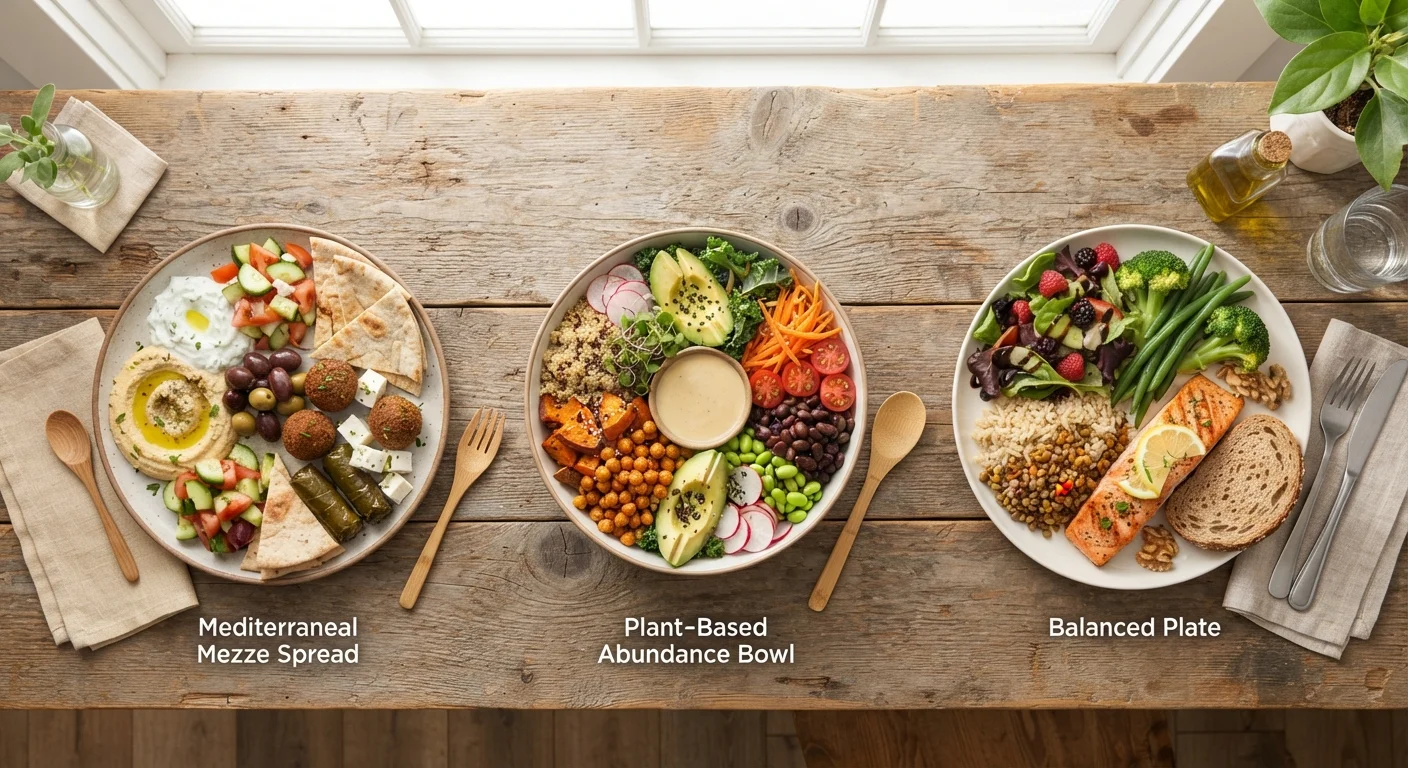
What Each Pattern Actually Emphasizes
Understanding what differentiates these three eating patterns is the first step toward evaluating them fairly. Despite significant overlap, each has a distinct origin and emphasis.
Mediterranean Diet: Rooted in the traditional food cultures of countries bordering the Mediterranean Sea, this pattern centers on olive oil as the primary fat source, generous amounts of vegetables, legumes, whole grains, fish, and moderate dairy - typically yogurt and cheese. Red meat appears infrequently. Moderate wine consumption is part of traditional descriptions, though health guidance often treats this element separately. It is a dietary pattern, not a structured meal plan.
DASH Diet (Dietary Approaches to Stop Hypertension): Developed through clinical research funded by the National Heart, Lung, and Blood Institute, DASH was designed specifically to lower blood pressure without medication. It emphasizes fruits, vegetables, low-fat dairy, whole grains, lean proteins, and nuts while explicitly limiting sodium, saturated fat, red meat, and added sugars. Unlike the Mediterranean pattern, DASH was built around specific nutrient targets.
Plant-Based Diet: This term covers a wide spectrum - from flexitarian approaches that simply de-emphasize animal products, to fully vegan diets that eliminate them entirely. What distinguishes a health-oriented plant-based diet from simply eating less meat is the focus on whole plant foods: legumes, vegetables, fruits, nuts, seeds, and whole grains, rather than ultra-processed plant-derived alternatives. See our guide to protein sources across eating patterns for detail on meeting protein needs within this framework.
What the Research Actually Shows
Each pattern has a meaningful body of evidence, though the type and strength of that evidence varies.
~30%
Reduction in major cardiovascular events
The PREDIMED trial found approximately a 30% lower rate of major cardiovascular events among Mediterranean diet groups versus low-fat controls, though the study was later partially corrected for randomization errors.
8-14 mmHg
Systolic blood pressure reduction with DASH
Clinical trials have reported systolic blood pressure reductions of this magnitude in individuals with hypertension following the DASH diet, according to NHLBI-supported research.
~16%
Lower cardiovascular disease risk
A meta-analysis published in the Journal of the American Heart Association found plant-based dietary patterns associated with roughly 16% lower cardiovascular disease risk compared to non-plant-based diets.
The Mediterranean diet has arguably the broadest research base. The PREDIMED trial - a large randomized study - associated it with reduced rates of major cardiovascular events compared to a low-fat control diet. Numerous observational studies also link it to lower risks of type 2 diabetes, cognitive decline, and certain cancers, though observational data cannot establish causation on its own.
The DASH diet has strong randomized controlled trial evidence specifically for blood pressure reduction. Studies have shown meaningful reductions in both systolic and diastolic blood pressure, particularly when sodium is also restricted. Its evidence base for cardiovascular outcomes is strong, though some researchers note it is less studied outside clinical contexts than the Mediterranean pattern.
Research on plant-based diets shows associations with lower body weight, reduced LDL cholesterol, and lower cardiovascular risk in well-planned forms. However, poorly planned versions - particularly those relying heavily on processed meat substitutes - may not confer these benefits. Nutrient gaps, especially in vitamin B12, iron, omega-3 fatty acids, and calcium, require deliberate attention. For those concerned about nutritional thinking traps, the plant-based category is especially prone to marketing-driven misunderstandings.
Side-by-Side Comparison
The table below summarizes key characteristics across practical dimensions that matter to everyday decision-making.
| Mediterranean | DASH | Plant-Based | |
|---|---|---|---|
| Primary health focus | Cardiovascular & overall health | Blood pressure reduction | Cardiovascular & metabolic health |
| Animal products allowed | Yes (fish, dairy, limited meat) | Yes (lean meat, low-fat dairy) | No, minimal, or optional (spectrum) |
| Sodium guidance | Not explicitly restricted | Explicitly limits sodium intake | Varies by individual foods chosen |
| Fat type emphasized | Olive oil, unsaturated fats | Low saturated fat; limits total fat | Varies; nuts and seeds encouraged |
| Ease of adoption | Flexible, minimal rules | Structured nutrient targets | Requires planning, especially protein |
| Nutrient gap risks | Generally low | Generally low | B12, iron, omega-3, calcium |
| Strength of evidence | Large RCTs and observational data | Strong RCT evidence for BP | Strong observational; varies by subtype |
It is worth noting that these patterns are not mutually exclusive. Someone following DASH principles can incorporate Mediterranean-style olive oil use, or reduce animal products in a plant-forward direction. Dietary patterns are frameworks, not rigid rulebooks - a point supported consistently in nutrition research.
For readers working within a grocery budget, many core foods across all three patterns - dried legumes, frozen vegetables, canned fish, whole grains - are genuinely affordable. Our guide to eating well on a budget covers strategies that apply across all three patterns.
Choosing a Pattern That Fits Your Life
Research consistently shows that long-term adherence drives outcomes more than which specific pattern a person follows. A diet that scores well in clinical trials but that someone cannot realistically maintain provides limited real-world benefit.
Start With Overlap, Not Differences
All three patterns share a foundational principle: eat more whole, minimally processed plant foods and less refined sugar and ultra-processed food. If choosing between them feels overwhelming, starting with that shared foundation - before worrying about which label fits - is a practical and evidence-supported approach. Incremental changes tend to be more durable than complete dietary overhauls.
Cultural fit matters. The Mediterranean pattern, for example, reflects Southern European food traditions that may not map naturally onto every American household's existing food culture. Adapting core principles - increasing vegetables, using healthier fats, reducing processed foods - often works better than wholesale replacement of familiar foods.
Health context also shapes the decision. Someone managing hypertension or kidney disease may benefit most from DASH's structured sodium and protein guidance. Someone with ethical concerns about animal agriculture may find a well-planned plant-based approach most motivating. Those looking for a broadly health-supportive framework with minimal restriction often find the Mediterranean pattern the easiest entry point.
If you are new to thinking deliberately about food composition, building a balanced plate offers a practical foundation before committing to any named pattern. And if you are comparing these patterns to time-restricted eating approaches, our overview of intermittent fasting evidence provides a balanced counterpoint.
This article is for general informational and educational purposes only and does not constitute medical or dietary advice. Consult a qualified healthcare provider or registered dietitian before making significant changes to your diet, especially if you have existing health conditions.