What 'Sensitive Skin' Actually Means
Sensitive skin is not one condition - it's a category of responses. Some people have a compromised skin barrier that lets irritants in too easily. Others have a heightened immune response that triggers redness or stinging. Still others are reactive to specific ingredients without any underlying diagnosis. Before building a routine, it helps to understand which pattern applies to you.
Common signs include stinging after applying water-based products, redness that comes and goes without a clear cause, and persistent dryness or tightness. These can all have different roots - from rosacea and eczema to simple over-exfoliation. Understanding your triggers is the foundation. If you're unsure, a board-certified dermatologist can help rule out conditions that require more than a product swap.
This article is general skincare information only, not medical or dermatological advice. Consult a qualified healthcare professional for persistent skin conditions.
Ingredients to Approach with Caution
Reading a label matters more for sensitive skin than for any other type. Our guide Skincare Ingredient Labels, Decoded explains how ingredient lists are structured - understanding concentration order alone can prevent a lot of mistakes.
The most common culprits for reactive skin fall into a few predictable categories:
- Fragrance - listed as "fragrance," "parfum," or specific essential oils. It's one of the leading causes of contact dermatitis and offers no functional skincare benefit.
- Alcohol denat. (denatured alcohol) - used as a solvent and preservative, but can strip the skin barrier when used at high concentrations.
- Preservatives - methylisothiazolinone (MI) and methylchloroisothiazolinone (MCI) are flagged by many dermatologists as frequent sensitizers. Phenoxyethanol at low concentrations is generally considered better tolerated.
- Strong exfoliating acids - glycolic acid at high concentrations can be too aggressive; lactic acid is typically gentler and may be better tolerated for sensitive types.
Not Every Reaction Means the Product Is Wrong
Some redness or tingling when starting a new product can reflect adjustment rather than a true allergic response. That said, burning, swelling, or hives are different signals - stop use immediately if those occur. When in doubt, consult a dermatologist rather than pushing through discomfort.
Not every sensitizing ingredient is universally harmful. Reactions are individual, and a product that causes issues for one person may be fine for another. The goal is to reduce your exposure to the highest-risk additives first, then test methodically from there.
How to Build the Routine Itself
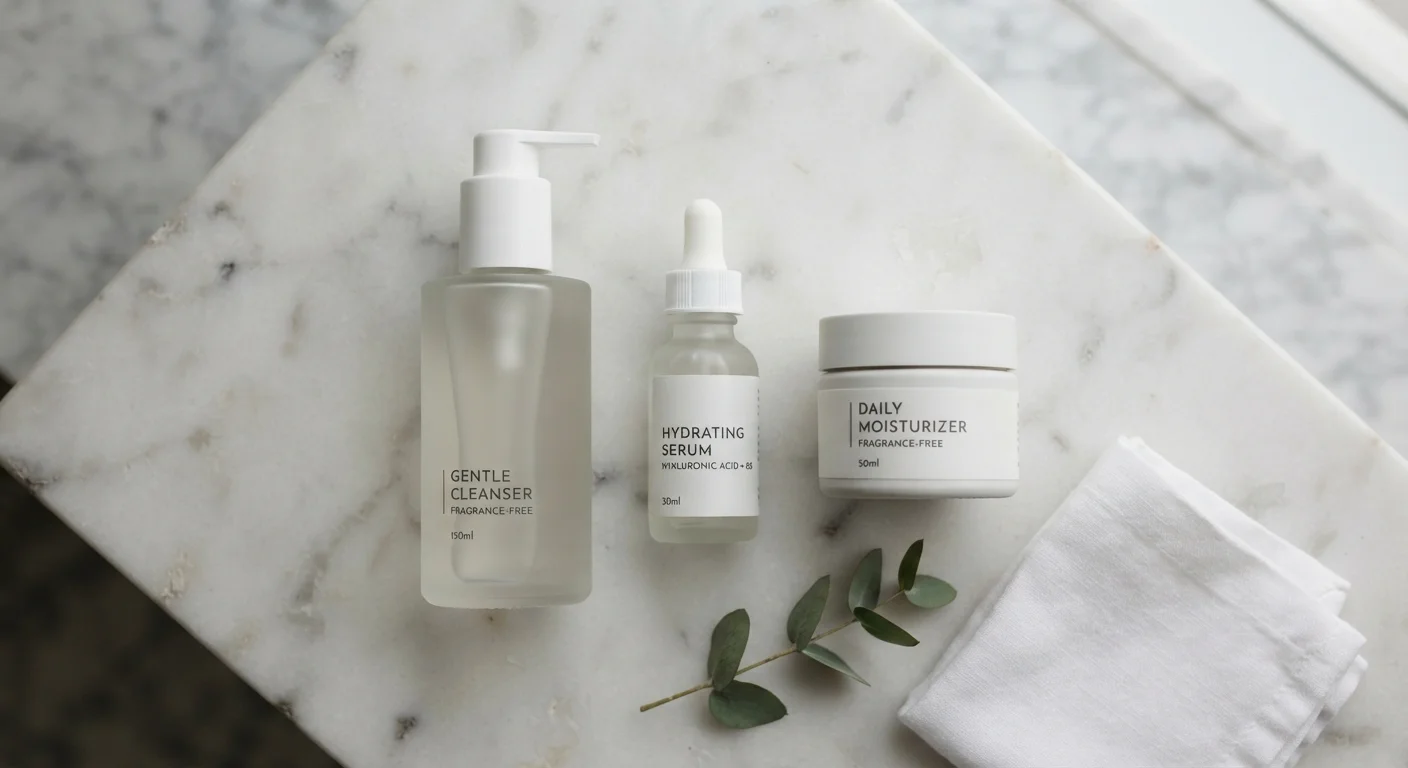
The core principle for sensitive skin is reduction before addition. Start with the fewest possible products: a gentle, low-pH cleanser, a plain moisturizer, and SPF during the day. Only after you've established tolerance for that baseline should you consider adding anything else.
Introduce one new product at a time, with at least one week between each addition.
Adding multiple products simultaneously makes it impossible to identify what caused a reaction. A staggered approach gives your skin time to respond and gives you clear information about what's tolerable.
Choose fragrance-free formulas as a default starting point.
Fragrance - synthetic or natural - is among the most common causes of contact dermatitis. Eliminating it from your routine removes a variable that carries risk with no functional benefit to skin health.
Keep your cleanser mild and your water temperature lukewarm.
Hot water and stripping cleansers both disrupt the skin barrier. A compromised barrier is the gateway to increased sensitivity, so protecting it at the cleansing step matters.
Moisturize immediately after cleansing, while skin is still slightly damp.
Applying a moisturizer to damp skin helps trap water before transepidermal water loss occurs. For barrier-compromised skin, this timing makes a measurable difference in hydration retention.
Avoid layering too many actives, even if each one is individually well-tolerated.
Interactions between active ingredients - exfoliating acids, retinoids, vitamin C - can cause cumulative irritation even when each product is used correctly on its own.
Your morning and evening routines serve different purposes, and sensitive skin should take that seriously. Actives like retinoids or exfoliating acids, if you use them at all, belong at night - and only after your skin has had time to adjust to your baseline routine.
Patch Testing: The Step Most People Skip
Patch testing is the single most effective way to screen a product before it touches your whole face. Our detailed walkthrough The Patch Test: Why It Matters and How to Actually Do It covers the exact method and timeline - read it before introducing anything new.
The general principle: apply a small amount of the new product to the inside of your wrist or behind your ear. Wait 24-48 hours and observe. No reaction doesn't guarantee full-face tolerance, but it significantly lowers your risk.
Keep a Simple Skincare Log
You don't need an app or spreadsheet - a note on your phone listing product name, start date, and any observations is enough. This record is especially valuable when talking to a dermatologist, because it takes the guesswork out of identifying problem ingredients.
Staying Consistent Without Overcomplicating It
Sensitive skin benefits more from consistency than from variety. Resist the pull of new launches and multi-step systems. Once you have a routine that works, give it 4-6 weeks before evaluating. Skin takes time to adjust, and swapping products too quickly makes it impossible to know what's actually helping.
~50%
People who self-report sensitive skin
Studies published in dermatology journals estimate that roughly half of adults self-identify as having sensitive skin, though clinical diagnosis rates are significantly lower.
#1
Most common cause of cosmetic contact dermatitis
Fragrance is consistently identified by dermatologists and contact allergy researchers as the leading cause of cosmetic-related allergic contact dermatitis.
Track what you use and when. A simple note on your phone - product name, date introduced, any reactions - creates a reference that saves time and skin in the long run. If something causes a reaction, you'll know exactly what to remove.