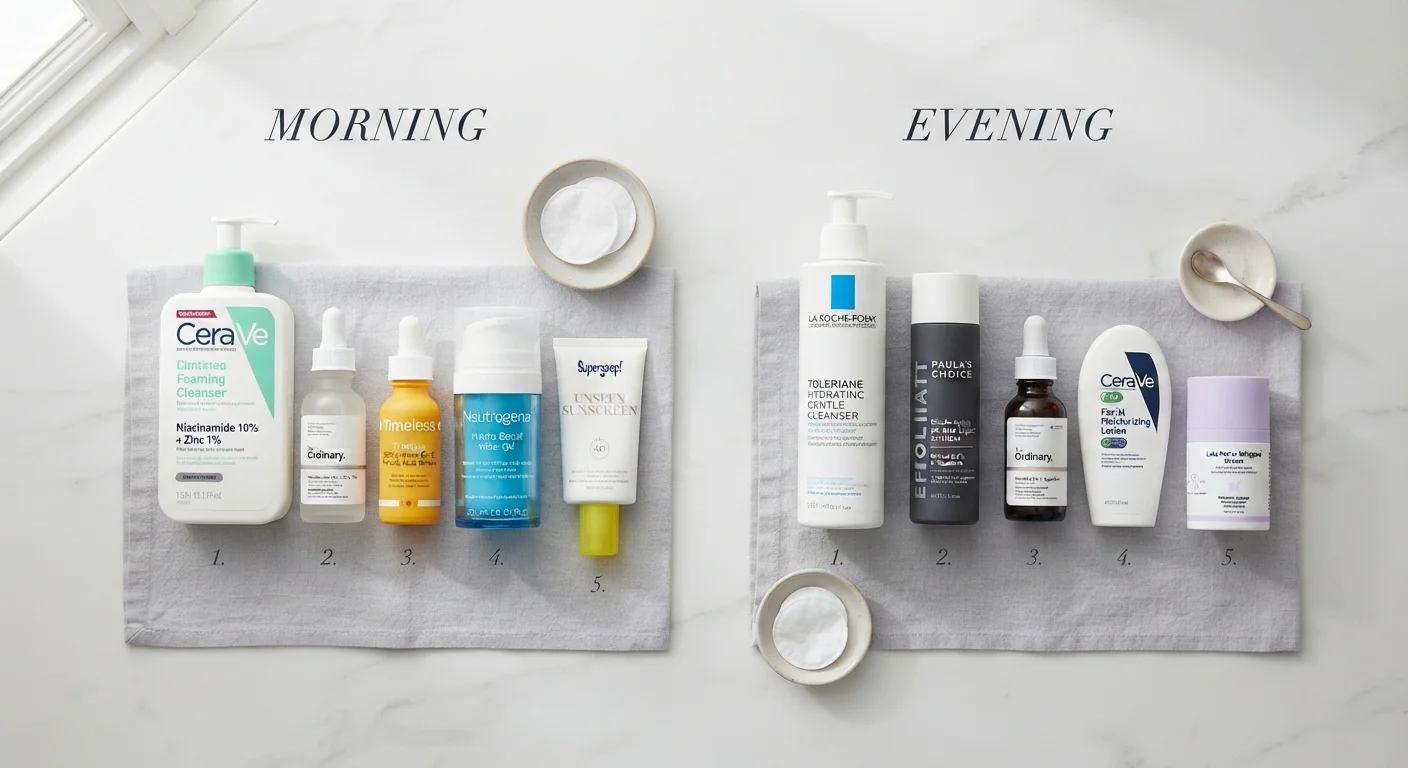
The Core Logic: Defense vs. Recovery
Your skin operates on a circadian rhythm. During the day, it acts as a barrier - defending against UV radiation, pollution, and oxidative stress. At night, cellular repair ramps up: skin cell turnover accelerates and the barrier rebuilds. Building your routine around this biology isn't trend-chasing - it's just working with your skin instead of against it.
Morning skincare's job is straightforward: protect what you have. Evening skincare's job is to support what your skin is already doing while you sleep. When you blur that line - say, by using your PM treatment serum in the morning or skipping SPF because you already moisturized - you undermine both goals. For a closer look at how to sequence products within each routine, see skincare layering order explained step by step.
What Belongs in Your Morning Routine
The non-negotiable in any AM routine is SPF. Broad-spectrum sunscreen - typically SPF 30 or higher - protects against UVA (aging) and UVB (burning) rays. Nothing in your evening lineup substitutes for this.
Antioxidant serums, particularly those containing vitamin C (as L-ascorbic acid), are well-suited to mornings. Applied under SPF, they help neutralize free radicals generated by UV and pollution exposure. Vitamin C is also light-sensitive and can degrade with prolonged UV exposure if applied at night without benefit - morning use is more purposeful.
A gentle, non-stripping cleanser rounds out the foundation. Overnight, skin produces sebum and sheds dead cells, so a light cleanse makes sense. Heavy exfoliation in the morning, however, is generally unnecessary and can leave skin more vulnerable to sun damage during the day.
Keep Morning Routines Short
Fewer steps in the morning reduces the risk of ingredients interacting badly before SPF goes on. A cleanser, one antioxidant serum, a moisturizer, and sunscreen covers the essentials without complexity. Save the multi-step treatment work for your PM routine when skin has time to process it.
What Belongs in Your Evening Routine
Night is when actives earn their keep. Retinoids - a category that includes retinol (over-the-counter) and tretinoin (prescription) - are the most well-researched ingredient class for skin renewal. They're photosensitive, meaning UV exposure breaks them down before they can work; they also increase skin's sensitivity to sun damage. Evening application is not a preference but a functional requirement.
Chemical exfoliants like AHAs (glycolic, lactic acid) and BHAs (salicylic acid) also fit better at night. They temporarily loosen the top layer of skin, which can heighten UV sensitivity - a problem easily avoided by using them before you sleep. If you're unsure which actives can safely share a routine, learn which combinations to avoid before layering multiple treatments.
A richer moisturizer or barrier-support cream at night can take advantage of the skin's heightened permeability during repair hours - ingredients like ceramides, peptides, and niacinamide have good evidence for overnight use.
| Morning Routine | Evening Routine | |
|---|---|---|
| Primary purpose | Protection from UV and oxidative stress | Support skin repair and cell turnover |
| Cleanser type | Gentle, light cleanse | Thorough removal of sunscreen and pollutants |
| Vitamin C | Yes - enhances SPF defense | Less effective; can degrade without UV benefit |
| Retinoids | Avoid - photosensitive and sun-sensitizing | Primary window; works during cell renewal phase |
| AHAs / BHAs | Use with caution; increase UV sensitivity | Preferred timing; no immediate sun exposure |
| SPF | Non-negotiable, last step | Not applicable |
| Moisturizer weight | Light to medium; comfortable under SPF | Medium to rich; supports overnight barrier repair |
Common Mistakes That Undermine Both Routines
The most frequent error is treating AM and PM as identical. Using a retinol product in the morning without SPF immediately after, or relying on moisturizer with SPF as your only sun protection while also applying actives, creates gaps in both protection and treatment.
Another common issue: over-layering actives at night because "more is more." Combining retinoids with AHAs in the same PM routine, for example, can cause significant irritation without improving outcomes. See which active ingredient combinations to avoid before stacking treatments.
Reading ingredient labels accurately is foundational to getting this right. If you're unsure how to parse a product's INCI list or understand where an ingredient sits in concentration, skincare ingredient labels decoded is a useful starting point. For those with sensitive skin, building a routine for sensitive skin covers how to introduce actives slowly without triggering reactions.
This article is for general informational and educational purposes only. It is not a substitute for professional dermatological or medical advice. Consult a licensed dermatologist for guidance specific to your skin type, conditions, or concerns.