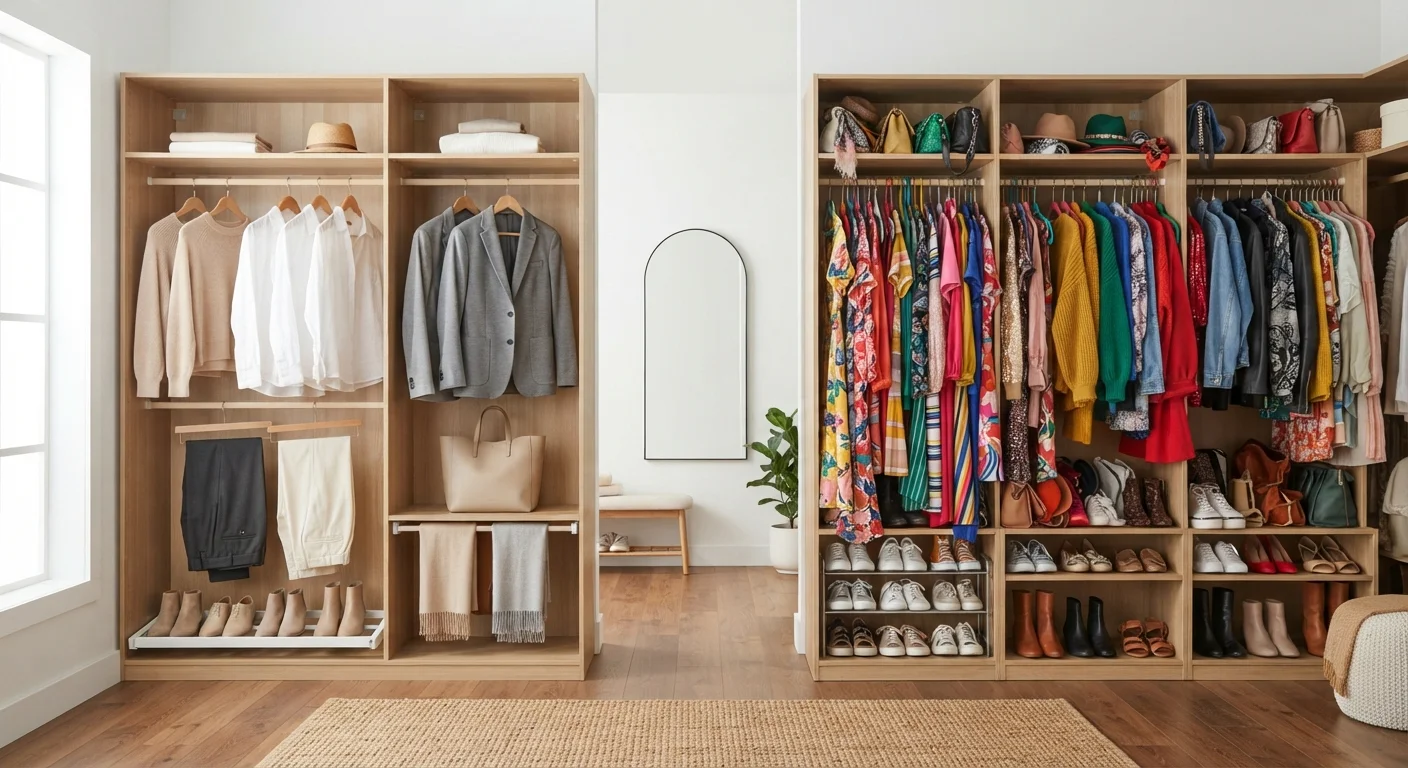
What Each Approach Actually Means
The term capsule wardrobe refers to a deliberately small, cohesive set of clothing - typically 30 to 50 pieces - chosen so that nearly every item can pair with nearly every other. The idea was popularized in the 1970s by London boutique owner Susie Faux, and it centers on neutrals, classic cuts, and high per-wear value. Nothing sits unused.
A full closet, by contrast, has no defined upper limit. It accommodates statement pieces, trend items, occasion-specific garments, and duplicates. The trade-off is breadth over cohesion - you have more options, but not every item works with everything else.
Neither label means the same thing to every person. Some people call a closet of 80 items a capsule; others consider 30 pieces excessive. What matters more than the count is the underlying logic: are you buying and keeping clothes intentionally, or by accumulation?
For a broader framework on building clothes that work together, see the core principles behind versatile dressing.
Comparing the Two Approaches
The differences between these systems show up most clearly when you examine specific trade-offs side by side.
| Capsule Wardrobe | Full Closet | |
|---|---|---|
| Typical item count | 30-50 pieces | No fixed limit; often 80+ |
| Daily decision-making | Simplified; fewer combinations | More options; can increase effort |
| Upfront cost | Varies; quality-focused spending common | Varies; spread across more items |
| Adaptability to varied occasions | Limited without sub-wardrobes | Better suited to wide dress-code range |
| Organization demands | Low; fewer items to track | Higher; requires regular auditing |
| Room for self-expression | Constrained by cohesion goals | More flexible and expressive |
| Maintenance burden | Lower; each item used more often | Higher; risk of forgotten items |
A few of these rows deserve unpacking. On cost, people often assume capsule wardrobes save money because they involve fewer pieces - but if each piece is expensive, total spend can still be high. Conversely, a large closet filled with low-cost items isn't necessarily cheaper in the long run if garments wear out quickly. The variable is spending habits, not closet size.
On decision fatigue, the capsule model does have documented appeal: fewer options can simplify morning routines. But a well-organized full closet with consistent color coordination can achieve similar results. Common fashion myths - like the idea that more clothes always means more choices - are worth examining before committing to either system.
When a Capsule Wardrobe Makes Sense
A capsule approach tends to work well for people whose daily life is relatively consistent. If you work in a single environment - say, a business-casual office five days a week - and your weekend activities don't vary wildly, a small set of interchangeable pieces covers most situations without excess.
It also suits people who dislike shopping or who find the maintenance of a large wardrobe draining. Fewer items means less folding, less storage pressure, and less time spent doing laundry on rotation. The fabric care habits that extend garment life become more impactful when you're depending on each piece more frequently.
Test Before Committing to a Capsule
Before discarding half your wardrobe, try a structured experiment: for 30 days, limit yourself to a defined set of pieces and note what you actually miss. This reveals whether your current variety is functional or just habitual. Items you don't miss after a month are strong candidates for removal.
The capsule model is harder to sustain if your dress-code range is wide. Someone who needs formal attire for client meetings, activewear for daily workouts, and casual clothes for weekends is effectively managing three sub-wardrobes - which is not the same as one tightly curated capsule.
When a Fuller Closet Makes More Sense
A larger wardrobe is rational, not wasteful, when your life genuinely requires variety. People who attend a broad range of events - from black-tie occasions to outdoor activities - or whose professional environment demands specific dress codes will find a minimal closet limiting. For a clear breakdown of what various occasions actually require, dress codes demystified is a useful reference.
A fuller closet also suits people for whom clothing is a meaningful form of self-expression. If experimenting with color, silhouette, and proportion is something you actively enjoy, constraining yourself to a capsule can feel restrictive rather than freeing.
The risk with a larger collection is organizational drift - items get forgotten, duplicates accumulate, and the closet stops functioning efficiently. The system only works if you regularly audit what you own. Before adding any new piece, running through a structured checklist helps avoid accumulation without intention. See this pre-purchase checklist for a practical framework.
A Larger Closet Still Needs a System
Without periodic audits, a full closet tends to grow beyond what you can practically use. Clothes get pushed to the back, forgotten, or duplicated without realizing it. If you can't see an item, you won't wear it - meaning the cost-per-wear climbs even as the closet fills. Plan a seasonal review to keep the collection functional rather than just large.
The Middle Ground Most People Actually Live In
In practice, most people don't operate at either extreme. A more realistic picture is a closet with a reliable core of versatile pieces - functioning like a capsule - plus a peripheral layer of occasion-specific or expressive items that don't need to mix with everything else.
This hybrid model doesn't have a catchy name, but it's probably the most functional approach for the average American consumer with a varied lifestyle. It allows intentionality without rigidity. You get the efficiency of a curated core while keeping room for the pieces that reflect personality or serve specific needs.
Whether you're building from scratch or reassessing what you already own, buying secondhand is worth considering as part of either approach - it changes the economics without necessarily changing the strategy.
Ultimately, the goal of any closet system is the same: clothes that fit, that you'll actually wear, and that don't require constant mental overhead to manage.