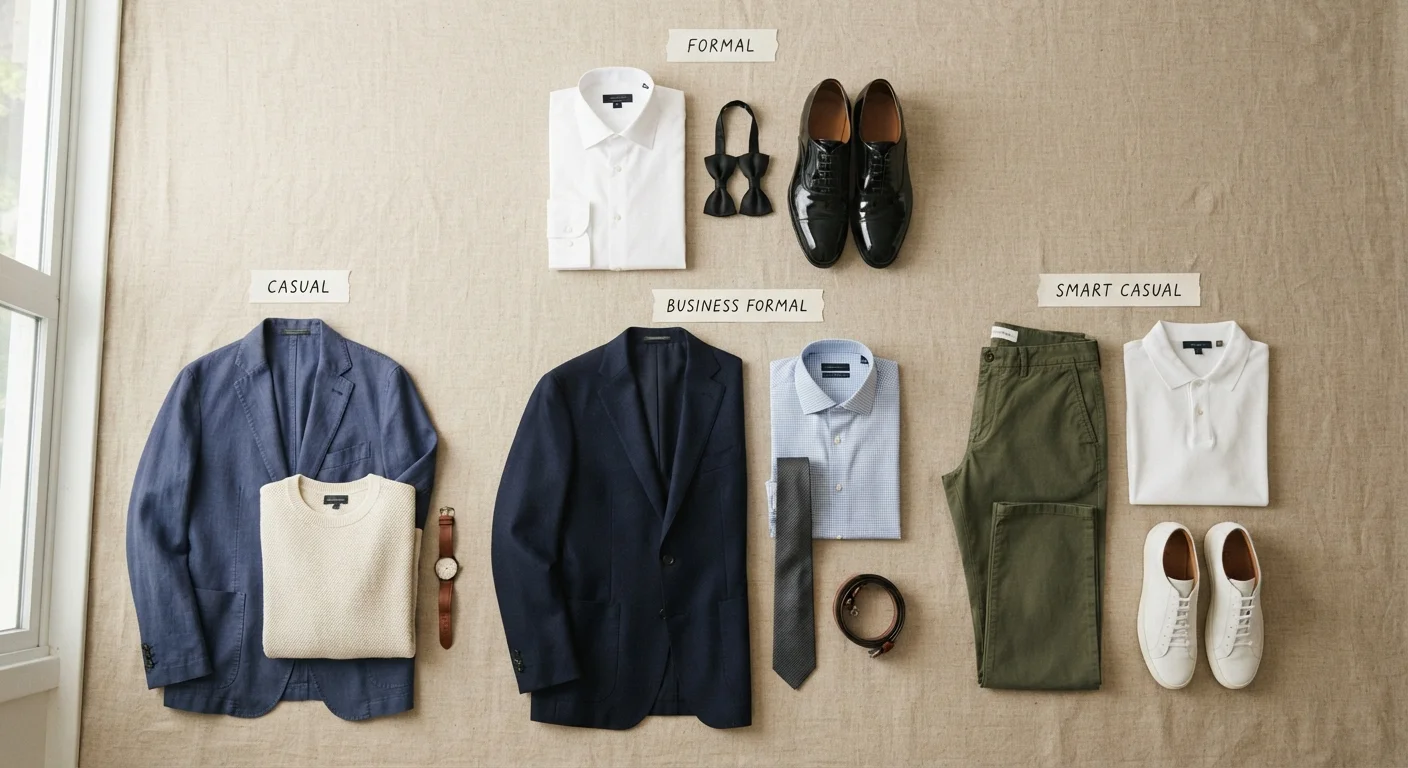
The Dress Code Spectrum, Explained
Dress codes exist on a rough continuum from fully relaxed to highly ceremonial. Understanding where each label falls - and what it actually requires - saves you from showing up in chinos to a black-tie dinner or an ill-fitting suit to a casual rooftop party.
Here is how the major dress codes break down in practice:
- Casual: Everyday clothes that are clean and situationally appropriate. Jeans, T-shirts, and sneakers are fair game, but ripped or stained clothing still falls short.
- Smart Casual: The most frequently misread code. It bridges relaxed and polished - think dark jeans or chinos paired with a fitted top and leather shoes or neat flats. Graphic tees and athletic wear miss the mark.
- Business Casual: Structured, workplace-appropriate clothing without requiring a full suit. Dress trousers or neat chinos, a collared shirt or blouse, and closed-toe shoes are the baseline. Denim is sometimes acceptable depending on the workplace culture.
- Business Formal / Professional: A matched suit or skirt suit in a neutral color, dress shirt or blouse, and formal footwear. This is the standard for courtrooms, senior-level interviews, and formal corporate environments.
- Cocktail Attire: An elevated social dress code - knee-to-midi-length dress, or a dark suit with a tie. More festive than business formal, but a full-length gown is typically too much.
- Black Tie: A tuxedo for men (black jacket, formal trousers, bow tie, dress shirt) and a floor-length evening gown or formal cocktail dress for women. This code has the clearest rules and the least room for improvisation.
- White Tie: The most formal dress code in existence - tailcoat, white waistcoat, and white bow tie for men; full-length ballgown for women. Rare outside of state dinners and formal galas.
Dress Codes Vary by Region and Generation
What counts as 'business casual' at a law firm in a major city may differ significantly from a startup in a college town. Generational expectations also shift the baseline - younger workplaces have largely relaxed business casual to allow clean sneakers and casual trousers that older corporate environments would still decline. When in doubt, observe what people in a given environment actually wear, not just what the official policy says.
The Most Misread Dress Codes
Smart casual generates the most confusion. The word "casual" leads people to interpret it loosely, but the word "smart" does real work. An outfit that reads as deliberate and polished - even if relaxed in fabric or silhouette - satisfies the code. Untucked worn T-shirts and athletic shoes do not, regardless of how clean they are.
Business casual is frequently underdressed in two ways: people either wear jeans that are too casual for the environment or skip structured pieces entirely in favor of "nice" athleisure. The distinguishing feature of business casual is structure - garments that hold their shape and signal intention.
Black tie optional confuses even experienced dressers. "Optional" refers to the tuxedo, not to formality overall. The dress code still expects evening-wear-level dressing; a dark, well-fitted suit is the floor for men, not the ceiling. Women should aim for cocktail-length or floor-length - not a casual midi dress.
“Clothes are a form of communication. A dress code is really just the host setting the terms of that conversation - and showing up appropriately is how you signal that you heard them.”
— Tim Gunn, Fashion educator and author on style and professional dress
For a deeper look at the rules that tend to trip people up - including the myth that expensive always means better - see our breakdown of common fashion myths.
How to Read Context When the Code Is Unclear
Not every invitation specifies a dress code, and even when it does, context shapes the interpretation. Four reliable signals help decode ambiguity:
- Venue type: A five-star hotel ballroom sets a different expectation than a rooftop bar or a community garden. The venue's own register gives you a baseline.
- Time of day: Daytime events - brunches, afternoon ceremonies - trend less formal than evening events at the same venue. After 6 p.m. generally means darker colors and more structured silhouettes are appropriate.
- Industry or host culture: A creative agency's holiday party and a law firm's awards dinner can both say "business casual" and mean quite different things in practice.
- The occasion itself: Weddings, funerals, and milestone celebrations carry their own social weight; even without a stated code, the nature of the event communicates the appropriate register.
When you are genuinely uncertain, reaching out to the host is a completely reasonable move - it signals respect for their event rather than ignorance.
When in Doubt, Ask the Host
If an invitation's dress code is genuinely ambiguous, a brief, polite message to the host is always appropriate. Most hosts appreciate the question - it shows you're taking the event seriously. Keep it simple: 'I want to make sure I'm dressed appropriately - would you say [X] fits the vibe?' is enough.
Building a wardrobe that covers multiple dress code levels without redundancy is its own skill. Our guide to versatile dressing fundamentals covers how to assemble pieces that move across contexts without overspending.
Practical Strategies for Getting It Right
A few straightforward habits make dress code navigation much easier:
- Anchor to one reliable piece per level. A well-fitted blazer, for instance, moves easily from smart casual to business casual to cocktail when paired thoughtfully. Understanding how pattern and texture affect how an outfit reads helps you use the same pieces in different combinations without looking repetitive.
- Fit matters more than price point. A correctly fitted garment at any price reads as more intentional than an expensive piece that doesn't fit well.
- Lean slightly formal when uncertain. The social cost of being slightly overdressed is almost always lower than the cost of being underdressed, particularly at professional or milestone events.
- Color discipline helps at formal levels. The more formal the code, the narrower the conventional color palette - blacks, navy, charcoal, ivory. Departing from those at black tie requires genuine intentionality. For guidance on building outfits with color, our practical guide to color combinations is a useful starting point.
5
Major dress code levels in common use
Most everyday Americans encounter casual, smart casual, business casual, cocktail, and black tie across their professional and social lives.
~6 PM
Time threshold that shifts formality expectations
Evening events - generally those beginning at or after 6 PM - conventionally call for darker colors, more structured silhouettes, and elevated fabrics.
Dress codes ultimately exist to set a shared expectation for an event - and reading them accurately is a practical skill, not a test of insider knowledge. With a clear map of what each level requires, you can make confident decisions without second-guessing every item in your closet.