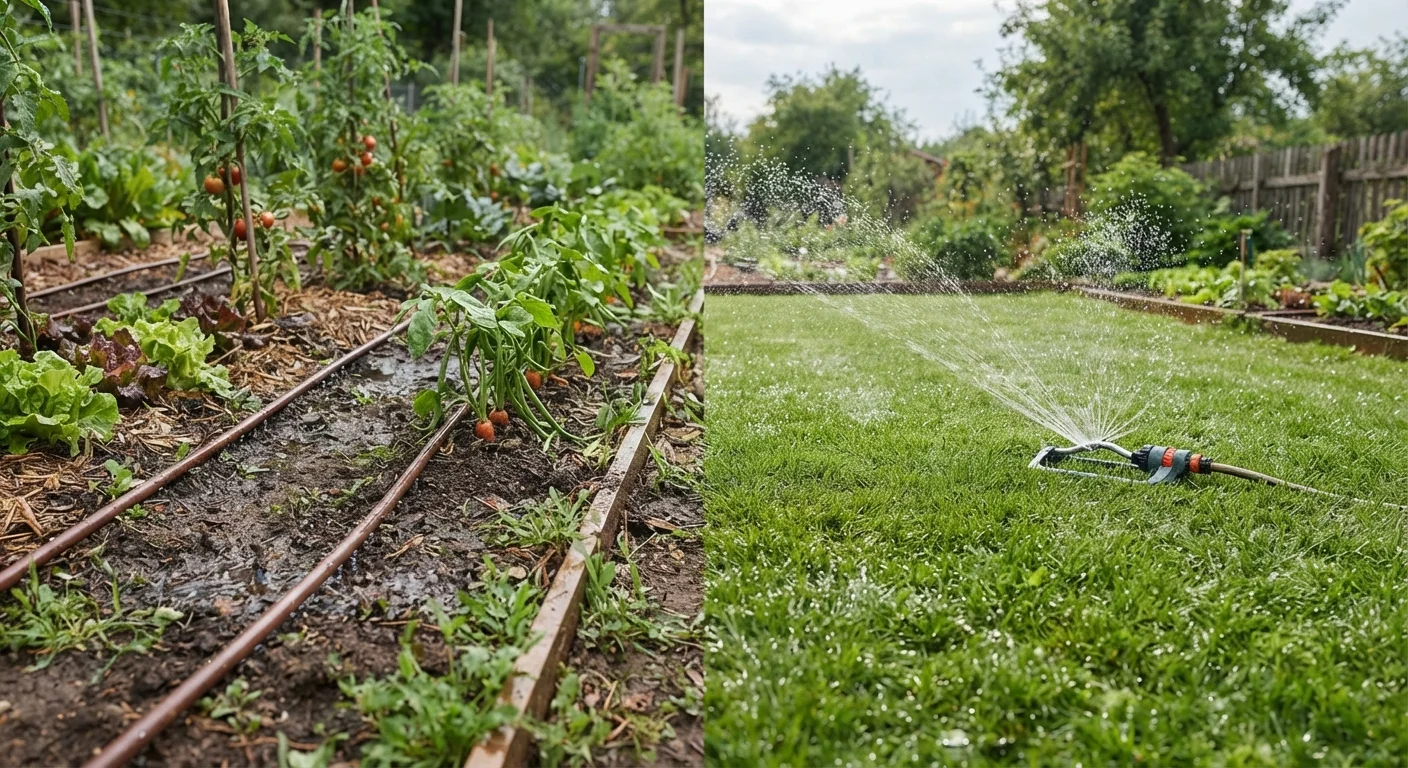
How Each System Works
Understanding the mechanics of each method makes the trade-offs obvious from the start.
Drip irrigation runs low-pressure water through a network of tubing and emitters placed at or just below the soil surface. Water seeps out slowly - typically one to four gallons per hour per emitter - directly into the root zone. Because water never reaches the leaves, foliar fungal diseases associated with overhead moisture are less likely to take hold.
Sprinkler systems distribute water through rotating heads, fixed spray heads, or impact sprinklers mounted above ground. Water is broadcast over an area in a pattern determined by head spacing, nozzle type, and water pressure. This makes sprinklers well-suited to covering turf uniformly, but water that lands on foliage or bare soil between plants is largely lost to evaporation.
If you're still figuring out how much water your specific plants need before committing to a system, see our guide on lawn watering amounts for a grounded starting point.
Head-to-Head: Key Practical Differences
The comparison below covers the factors that matter most to everyday gardeners - cost, efficiency, installation, and maintenance.
| Criterion | Drip Irrigation | Sprinkler Systems |
|---|---|---|
| Water efficiency | High - minimal evaporation | Moderate - evaporation and drift losses |
| Upfront installation cost | Moderate to high per sq ft | Low to moderate for basic setups |
| Best coverage area | Defined beds, rows, containers | Lawns, large open planting areas |
| Foliar disease risk | Lower - foliage stays dry | Higher - overhead spray wets leaves |
| Maintenance complexity | Moderate - emitters can clog | Low to moderate - heads may misalign |
| Adaptability to layout changes | Moderate - tubing must be rerouted | High - heads and patterns adjust easily |
| Compatibility with timers | Excellent | Excellent |
One nuance worth noting: drip systems are more sensitive to clogging from mineral deposits and debris, so they require periodic flushing and filter cleaning. Sprinkler heads are simpler to inspect visually but can develop uneven coverage as nozzles wear or heads shift out of alignment over time.
Water Efficiency: What the Numbers Suggest
Drip irrigation is consistently cited by cooperative extension programs as one of the most water-efficient delivery methods available to home gardeners. Because water is applied slowly and directly, less is lost to surface runoff and evaporation - factors that become significant during warm or windy conditions.
30-50%
Potential water savings with drip vs. overhead spray
The EPA's WaterSense program notes that drip irrigation can use 30-50% less water than conventional overhead watering methods when properly installed.
50%
Water lost to evaporation in inefficient sprinkler systems
According to the EPA, conventional sprinkler systems can lose roughly half their water output to evaporation, wind, and runoff under poor conditions.
Early AM
Optimal sprinkler run time to reduce evaporation
Extension programs broadly recommend running sprinklers between 4 a.m. and 9 a.m. to take advantage of cooler temperatures and calmer winds.
Sprinklers, by contrast, apply water faster than most soils can absorb it, which can cause runoff on slopes or compacted ground. Timing sprinkler systems to run during early morning hours - when temperatures are lower and wind is calmer - meaningfully reduces waste, but overhead systems will still use more water than drip to achieve the same root-zone saturation.
For gardeners pairing either system with organic mulch, moisture retention improves substantially. Our guide on mulching garden beds covers how proper mulch depth works alongside irrigation to keep soil moisture stable.
Matching the Method to Your Garden Layout
Garden type is the single most reliable predictor of which system will serve you better.
- Vegetable and herb gardens: Drip irrigation is the stronger fit. Rows or clusters of plants can be served by individual emitters, and keeping foliage dry supports plant health. If you're setting up a new food garden, our guide to starting a vegetable garden from scratch covers how to plan layout and spacing before you run any tubing.
- Lawns: Sprinklers are the practical standard. Drip is technically possible under turf using subsurface systems, but the cost and complexity rarely make sense for typical residential lawns.
- Mixed beds and shrub borders: Either system can work, but drip is easier to dial in for individual plants with different water needs. Grouping plants with similar needs together - a practice called hydrozoning - makes both systems more efficient.
- Raised beds: Drip tubing laid on the bed surface works extremely well and pairs naturally with raised bed growing, where defined planting zones make emitter placement straightforward.
Permits and HOA Rules May Apply
Some municipalities restrict outdoor water use or require permits for in-ground irrigation systems, particularly those connected to main water lines with backflow preventers. Homeowners associations may also have rules governing visible irrigation hardware. Check local codes and association guidelines before installing any permanent system.